Saturday, July 13, 2013

Just Shelved


Pitch DarkPitch Dark by Renata Adler
My rating: 4 of 5 stars

Bow down to the collage novel! Long live the hybrid text!


My Love Is A Dead Arctic ExplorerMy Love Is A Dead Arctic Explorer by Paige Ackerson-Kiely
My rating: 3 of 5 stars

This collection intrigued me and I stuck with it, though in the end, it didn't stick to my ribs or blaze through with an unforgettable line. I think the more colloquial, story-telling prose poems were the most accessible of the collection, though they, too, seemed to deliberately elude a complete grasp.


My rating: 4 of 5 stars
Alternately helpful and discouraging meditations on writing; worth it for the portions set in the Pacific Northwest alone.


The Wheel of LoveThe Wheel of Love by Joyce Carol Oates
My rating: 4 of 5 stars

I admit that by the end of this large collection of stories, I was praying to myself, "please don't go crazy, please don't go crazy." Madness, obsessive thoughts, anxiety, drug use, familial death, and physical disfigurements all feature heavily in these dark pieces, all originally published by 1970. These are stories of their time, too: racial integration, counterculture in conflict with suburbia, trapped housewives, the decline of Detroit.

"Where Are You Going, Where Have You Been?" is by far the most famous story here, and it's really not overrated, in my opinion. I would group it among the most perfect, unsettling short stories written in the past 100 years. It's a distinctly American classic. Another classic would be "How I Contemplated the World from the Detroit House of Corrections and Began My Life Over Again." Love and sexuality loom as disruptive forces for the men and women of these stories, especially the women. Characters are paralyzed in adulterous hell or transfixed in moments of despair over a life that stretches predictably ahead. On the other side, those who choose the bohemian way fare no better. They are flying dangerously free, unmoored and despised.

Oates' stories depict a culture at a crossroads and railing within it. The smoothness of artistic production can be ripped apart by the intrusion of the other. The burden of performing personality is a sentence of permanent psychic anxiety.

From a stylistic standpoint, these are also worthwhile fictional experiments. Rather than conventional plots, many of the stories in this collection rely on snapshots in time of the same character. Sometimes, they are told backward. Sometimes, groupings of experience and advancing psychological states are captured beneath obtuse or leading subject headings. I enjoyed this organizational ingenuity and the way Oates' distinctive prose lingers on mental states and character impressions. Nothing is described dispassionately; in contrast, everything is experienced as intense, jarring, and grating on the senses. This technique does a good job in creating unease for the reader and illuminating the interiors of Oates almost uniformly troubled characters.

This was my first time reading Oates at length, but I definitely would like to read more of her fiction. I feel after completing The Wheel of Love that I've experienced that time period more viscerally than I have before.


View all my reviews

Wednesday, July 10, 2013

Artificial & Natural


Like many amateur smartphone photographers (and before smartphones, iPhoto & point-and-shoot aficionados), I take great pleasure in going to beautiful places and snapping eminently editable photos. Not that many areas in the Jackson Hole region need much of a boost in color saturation or sharpness, but still, the small tweaks here and there or the revelation of HDR make me feel that I've somehow done more than aimed and clicked. I've photographed.

Recently, I've been exploring the Gros Ventre region, which is full of pleasurable place names such as the Red and Lavender Hills, and is also the home of the most charming backcountry cabin I've ever encountered. Set betwixt a ridge and a burbling creek at the end of a scenic little dale, its outside was so perfect that I thought it might still be in use by the occasional Forest Service ranger. However, on closer examination, I found the cabin actually split in two and long-abandoned, even though its front windows still wavered with their original glass. In one side sat a 1940's era stove, and on the other, a built-in shelf and table. As to its owner, an hour of feverish internet research produced nothing, though I did uncover a snooty entry from an evaluator criticizing another Gros Ventre cabin's entry in the National Register of Historic Places. Historian snobbery, alive and well.

Klimt Stone

The Gros Ventre is defined by a massive 1925 landslide that brought an entire side of Sheep Mountain down in a crush of tons of rock and trees. The slide, in turn, dammed the Gros Ventre River to form Lower Slide Lake (the "Gros Ventre Slide" is also a locally-beloved breakfast dish at The Bunnery). Two years later, part of the dam gave way, flooding the nearby town of Kelly almost out of existence. Because of its devastation in the flood, Jackson stepped forward to become of the county seat of Teton County.

Evidence of the slide has not dissipated in the ninety odd years since it happened. Huge boulder fields and drowned trees rising eerily from the lake still attest to this past natural violence. Primarily composed of sedimentary Tensleep Sandstone, the rocks and boulders ejected from the mountainside have sometimes an orangish hue and are speckled with bright splotches of many-colored lichen. In my head, I've begun calling it Klimt Stone because this reminds me of Klimt's metallic, speckled, and variegated paint textures.

Burnt trees also lend themselves well to being re-interpreted and morphed into looming, portentous signifiers. The following was on an unnamed ridge (at least, unknown to me) bordering Granite Creek, which is south of Jackson. Against bluer-than-blue skies, the carbonized skin glitters--a stalk of coal.

And this brings us to cloudscapes--perhaps the easiest to manipulate into technicolor visions, mimicking the layering of paint pigment in the depth of the alabaster, the lemon, the champagne. Dialing up a cloudscape brings baroque and rococo heavenly vistas to mind--those windows into ethereality usually guarded by chubby putti with trumpets and garlands. The cherubim don't work for free in Wyoming, however. I've seen plenty of rare animals, including a wolverine (!), but so far, no swirling celestial babies. I'll keep you posted.


As I continue to walk the woods, thinking of my book, and continue to indulge my side interest in documenting new hikes and spectacles, the vividness of real nature and the artificiality of art and nature-translated-to-image continue to inform one another. Sometimes reading is the most vivid thing of all; sometimes writing feels like the shoddiest paintbrush to communicate what is real. Regardless, the richness of a life lived in art and in landscape imparts a reverence for all that hallows, communicates, and beautifies experience. The one is essential to the other.


(Painting: "Adele Bloch Bauer," Gustav Klimt)


Sunday, June 9, 2013

Green Vibrations


I am thinking over a phrase of Annie Dillard's this morning, encountered in her collection of meditations on writing, appropriately titled The Writing Life. "There is no shortage of good days," she writes. "It is good lives that are hard to come by. A life of good days lived in the senses is not enough. The life of sensation is the life of greed; it requires more and more. The life of the spirit requires less and less; time is ample and its passage sweet. Who would call a day spent reading a good day? But a life spent reading -- that is a good life."

It's an uncomfortably wise insight. Although I have never confused sensation-seeking with writerly preparation, it has nevertheless been an underlying motivator in many things I have done. I always feel an anxiety about missing things, or allowing experiences to remain undiscovered. In Jackson, it is some mythical canyon that haunts me: somehow obscure and crystalline; a field of wildflowers where no one is walking; a view from so high, that as I wrote once, "I can feel the cold on my eyes." Other places, it is about the potential of art, the potential of hitting just the right point of intoxication on food or wine, the potential that some person hides behind one of many turned shoulders, and that person has keys to unlock any number of things. It's what leaves me hungrily scanning the walls of cathedrals, looking for the original, homely paintwork, obsessed with even the humblest joints of the ceilings. I'd hate to think I missed it.

I think my assumption has always been that these moments of beauty will accrete, one layer of sand to the next, to make my soul altogether something fine and glittering, honed carefully and curated as I go. And yet, I often write so little of it. Why, I wonder.

Summer is upon us now, with its exquisite songbirds and trails, cleared at last of snow. In mid-May, it seemed that all the aspens and cottonwoods turned green at once. I thought of it as a susurration of some kind, completely undetectable to human ears, but nevertheless communicating spring through the groves, vibrating the landscape into a new incarnation of being. The green was so new; the operation itself so delicate. A miracle was gifted in a day, but a quotidian miracle, too, happening each May in a sudden sweep. And then summer. And then the sun and the obstinate eggshell blue.

It is a time of golden water in the evenings, and green trees etched in gold around it. The yellow of balsamroot flowers and the sentinels of violet lupine and monk's hood. Baby elk, tremulous on newly-jointed legs; a rather fat and pleased-with-himself marmot, like a caricature of an English friar; a miniscule duck who fed at the edge of a quiet stream, buoyantly bobbing up after each quarry.

A hard thing it is, to revise, when all of this is happening outside. The outdoors are a constant imprecation to leave the room and abandon the work. That mythical canyon taunts like a mirage. But ho hum,  another chance to gather strength and plug along anyway. To remember the life of the spirit. So many moments of muster, and then finally, I write about this color of green at last, and let go of that last nagging sensation, returning concentration to where it ought to be.


Saturday, April 27, 2013

Endings and New Beginnings

This morning, I couldn't sleep, so once more, I pulled out the warm slab of my laptop, and let its screen keep me company in that early hour (early for me, anyway), as the light of a new day spread across the walls and the floors.

Ten minutes ago, my wonderful sister and her wonderful boyfriend Sam brought me a mimosa and breakfast in bed (woot!) . Their timing couldn't have been better, because just moments before, I wrote the last sentence of my novel draft. Time to celebrate the next step, a new year, and a new decade.

It feels a little surreal and emotional. Soon, we will be packing up and heading for two days of relaxation in Montana. I'm bringing books, but not my book. Of course, there is still work to do. Hello, revision and rewrites! But for now, I'm settled in with the happiness of being done and leaving behind this stage for a new one, just as my character did an hour ago, crossing into her imagined future and spinning out into the ether of narrative possibility.

I want to toast my beautiful, supportive family and my wonderful friends and cheerleaders. I am so lucky to have you along on this ride. Your love, even from afar, gives me faith in myself and humankind in general. See, I told you this was the year of feeling feelings!

Okay, it's party time. Raising a glass to all of you!

Saturday, April 20, 2013

Marking Time With Words


Spring is a brown time in Wyoming. I noticed this anew as my plane flew low over the hills two days ago. Each time, I can pick out the road that curves against the bluffs south of town, and then we fly over one of the low hills that marks my own neighborhood, over the entirety of the town grid, and touch down--spectacularly--at the base of the snowcapped Tetons. That's what I noticed, however, as we flew over: a neverending swath of brown, and all the mountains still encased in snow. Bison welcomed me back, as did an intrepid weasel that somehow snuck into our suburban home, crept into my room, and, in illustration of every possible rodent horror story, hopped right onto the bed. This is the west, after all.

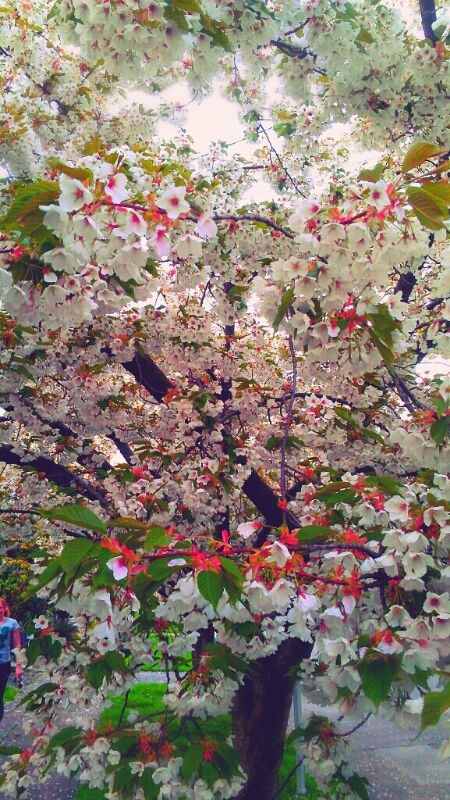
I was flying back from Seattle, my home of seven years, and where I had spent two luxurious weeks visiting with friends, celebrating a wedding, and remembering the riot of spring. Cherry blossoms, dogwoods, tulips, magnolias. Spring in Seattle is a time of carpet petals and palm-sized camellia flowers that fall, often unblemished, directly to the grass. It is a time of chill winds and spitting rain and oddly timed sunbreaks, too, but I couldn't help but feel that I'd picked an almost tropical locale as snow continued to drift in my hometown and the thermometer dropped back down to winter temperatures.

What does it feel like to be back in Seattle? It's an odd disjunction--more familiar to me in many senses than my life in Jackson, and yet the tugs of loyalty to Wyoming were there, too, as if, in choosing to spend these months in the mountains, I must swear fealty again to my vision, even as the warmth of my friends and the verdant scenery were things I could slip back into so naturally. I caught up with my friend Jessica, who now makes her home in the Bay Area after years spent in Seattle as well, and she remarked that visiting the city now feels like it once did to visit her hometown. This seems about right: the instant, comforting embrace of the known, not tinged by nostalgia, but rather by a deep sense of recognition. A marvel over what has changed, and yet an ease with what has not been forgotten: the buses I take, where we should choose a restaurant, where I should buy a book of poetry.


It's been months since I've ridden buses, and while I sat on one reading, I realized that the city had created a mode of thought for me in the rhythm of how I got from place to place; in the cadence of my walking, in my notation of businesses I passed, in my constant state of being around others in public spaces, and yet often burrowed into my own solitude. It was the same as I rode the bus from Portland to Seattle on a Sunday evening, a continuing drama of glowering clouds, rainbows, and sun outside the windows. I tried to take a picture of the clouds out of the glass, but I ended up taking one with the strip of setting sun from the opposite aisle smeared along the bottom of the frame. Like a double exposure or two counterpanes, tissue-thin, existing side by side. This was the feeling of being in Seattle. My old life close enough to taste and easy enough to resume, my new one waiting anxiously, afraid of being abandoned.

And yet. Part of living in Jackson feels like coming back to the beginning in the best way. Here, I have found new ways to think, too. In cars, playing my music and singing along like a banshee. On long, aimless walks while our dog Iris bounds unbidden into fields to chase the birds. In the feeling of electricity whenever a coyote howl pierces the dead of night or yes, even when a weasel sneaks into the house and brings everything that is outside, inside. I know the big question hangs there, swollen with the accumulation of months: Where will you go? And the truth is, I still don't know. I suppose I am still living the questions. I suppose my journey is meant to go a little further. At least the scenery will not disappoint. And at least I am reminded of the dear friends who support me and mean so much to me and whose much-needed company will no doubt buoy me through the rest of this month and beyond.

I am also turning 30 a week from today. It's a milestone that I want to meet with a marker. This week, I will complete my book. So, when I say I am marking time with words, I mean it very explicitly. This is the week. I will be holing myself up for as long as it takes so that I can emerge on the dawning day of my next decade and know that one thing I did in my twenties was finish my book. I will put the dot at the bottom of that question mark. I will move to the next sentence. And then, it will be time to move onto living another question, to finding another path in the trees.

Sunday, March 17, 2013

Just Shelved


The Marriage PlotThe Marriage Plot by Jeffrey Eugenides
My rating: 3 of 5 stars

I can't be the only English major or liberal arts graduate who read this book with a fond sigh of recognition. Ah, the college seminars, the days spent reading like it was your job, and that super annoying pretentious guy who always had a point to make in every. single. class. Like Madeleine, the novel's heroine, I was devoted to the unfashionable Victorian texts. Still am. I, too, never felt particularly edgy in my literary proclivities. I just liked to read. Still do. Those little digs of recognition end there, however, and become stymied in frustration. Maybe it's because this novel feels "low stakes." Do we really worry about anyone who's heartbroken at the tender age of 22? Especially if she's  already been accepted into a prestigious post-grad program and has the deposit money on hand for a Manhattan apartment? Is this self-consciously clever investigation and reappropriation of the marriage plot really necessary? It seems, actually, to be far more retrograde than those fusty old novels. Those heroines were so compelling that their marital hijinks were riveting--a sensitive reader is not wrapped up in the "romance" of these books, but rather enmeshed in the diminished possibilities for the brightest and most independent women depicted therein. At the end of Middlemarch, one does not close the book with a happy sigh that Dorothea and Will have been united at last. One closes it wistfully, looking forward to a century when a woman of Dorothea's gifts could *be* a finer version of Will Ladislaw. Now that that century has come, Madeleine disappoints. The men who vie for her affections are both more brilliant, and she is mired in class prejudice. She's not an entirely unsympathetic character, but she's certainly not representative of me or the other talented young women I knew in school. As a final note, the fate of Leonard Bankhead, my favorite character, disturbed me. Eugenides' ending seemed to imply that people who suffer from manic depression are de facto disqualified as stable partners or part and parcel of a happy ending. Haven't we come further than that very Victorian idea of madness?


The View from Castle RockThe View from Castle Rock by Alice Munro
My rating: 4 of 5 stars

I started this many times, and wasn't in the right zone until now. A more personal and less classical short story collection, View From Castle Rock is nonetheless engrossing and bracing, like everything Munro has ever written. Loved it.


View all my reviews

Sunday, March 3, 2013

Gold Leaf Fixations

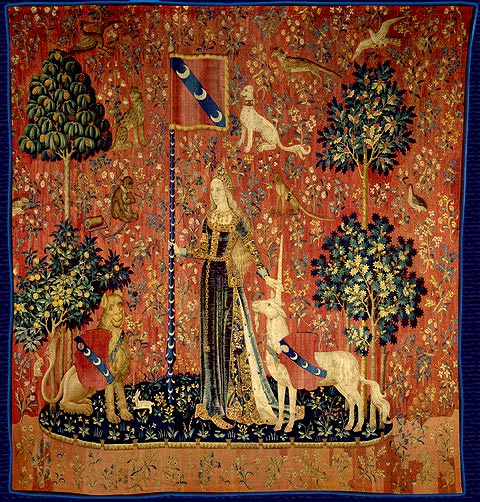
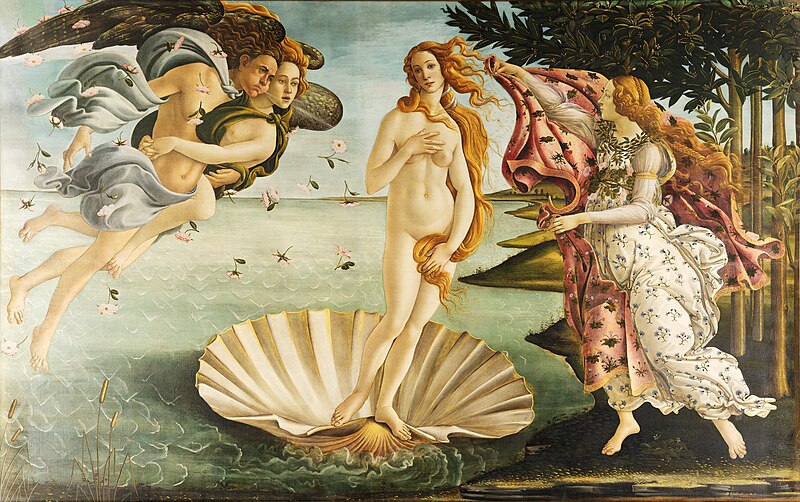
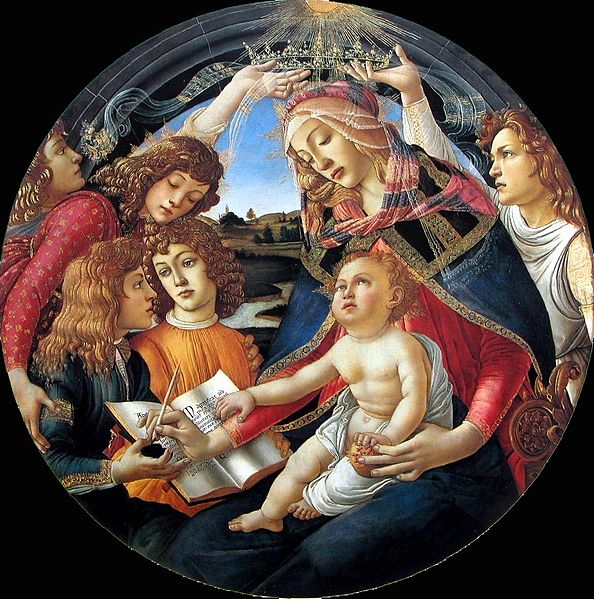
As writers, I think we cycle through various fixations. At different points of my life, I have been obsessed with silent film stars, describing snow, the personal effects of dead people, and medieval tapestries. The list goes on... Currently, I can't stop myself from Googling images and clips of classical ballet dancers. Curiosity feeds my art, even when there will be no pointe shoes in what I'm writing now, and only a little snow. Sick, sniffly, and cranky today, I combed through my own writerly archives and found these quite ancient poems. They brought me right back to my medieval portraiture/gold women fixation of seven years ago. I had just traveled to Europe that summer, and saw the Lady and the Unicorn tapestries in person. I loved those arch, stiff figures, and the symbolically mysterious cornucopia of creatures fixed at awkward angles around the maidens. Back in Seattle, I was cutting apart an old calendar of Botticelli's most famous paintings, and his flaxen-haired maidens painted centuries later called me back right away to the tapestries. Those same blonde maidens with the same faces, cast again and again as Madonnas and Venuses and Muses. I guess I'm still a little in love with them. Anyway, these two ekphrastastic (new word!) poems came directly from two of those uber-famous works. I post them here because, truth be told, I never was a very good poet, and this is really the only venue informal enough to share them. Also, they are oooolllldddd. Don't judge.


After Botticelli’s Birth of Venus

I am the bone white Venus.

I cut my feet when I walked to shore;

I wore clothes that were not my own

but my breasts glinted as pearls
inside my raiments.

The children came to touch my skin.

It wouldn’t be hidden

but glowed.

You are a body of fireflies!
They exclaimed.

My hair looped around the room like the rings of Saturn
and I spit seawater onto my plate.

Excuse her for she has just been born
they said in embarrassment.

I did not know the language yet
and my old tongue fled quickly,

twisted away like gilded fish.

They could not tell I wept
thought my tears a remnant of my salted womb

like the drippings from my limbs,
bursting into bloom on the plank wood floor.

Bless us!
they clamored.

I gurgled words I knew to them, uncomprehending;
the nymphs stole in at the sound and stole cheeses from

the bell dumb crowd

as I rang and rang them with a sound like whale calls.

That wicked baby who has dogged me flew in,
pinched my nipple.

I was dreaming of the shell, tongue-pink
my kelp body, drifting

insensate

just another unfound treasure in the deep

and now diminished, diminishing

trawled out and flaking light
like the most common catch,

Caught.


After Botticelli’s Madonna del Magnificat


Oh mother of the milky skin cry the angels.

There, I shall write in your book, pageboy;
you are prettier than girls.

The corona of my baby cuts into my breast,
my fingers slide over the slick seeds of the pomegranate.

Your wrists are lilies cry the angels.

My baby is fat and transfixed and heavy;
my skin is taut over my forehead.

I can feel the angels rotating my crown like a poker traced ‘ore my scalp
ear to ear.

Your hair golds like wheat cry the angels.
Your face is beautiful and fine like a shell.

I want them to waft this baby, this weight, away;
my robes stripped off

and float aimless like a star
unknown, unheralded, unflaxed with gold,

empty as I was born.

(all images: Wikipedia)