Showing posts with label literature. Show all posts

Saturday, July 13, 2013

Just Shelved


Pitch DarkPitch Dark by Renata Adler
My rating: 4 of 5 stars

Bow down to the collage novel! Long live the hybrid text!


My Love Is A Dead Arctic ExplorerMy Love Is A Dead Arctic Explorer by Paige Ackerson-Kiely
My rating: 3 of 5 stars

This collection intrigued me and I stuck with it, though in the end, it didn't stick to my ribs or blaze through with an unforgettable line. I think the more colloquial, story-telling prose poems were the most accessible of the collection, though they, too, seemed to deliberately elude a complete grasp.


My rating: 4 of 5 stars
Alternately helpful and discouraging meditations on writing; worth it for the portions set in the Pacific Northwest alone.


The Wheel of LoveThe Wheel of Love by Joyce Carol Oates
My rating: 4 of 5 stars

I admit that by the end of this large collection of stories, I was praying to myself, "please don't go crazy, please don't go crazy." Madness, obsessive thoughts, anxiety, drug use, familial death, and physical disfigurements all feature heavily in these dark pieces, all originally published by 1970. These are stories of their time, too: racial integration, counterculture in conflict with suburbia, trapped housewives, the decline of Detroit.

"Where Are You Going, Where Have You Been?" is by far the most famous story here, and it's really not overrated, in my opinion. I would group it among the most perfect, unsettling short stories written in the past 100 years. It's a distinctly American classic. Another classic would be "How I Contemplated the World from the Detroit House of Corrections and Began My Life Over Again." Love and sexuality loom as disruptive forces for the men and women of these stories, especially the women. Characters are paralyzed in adulterous hell or transfixed in moments of despair over a life that stretches predictably ahead. On the other side, those who choose the bohemian way fare no better. They are flying dangerously free, unmoored and despised.

Oates' stories depict a culture at a crossroads and railing within it. The smoothness of artistic production can be ripped apart by the intrusion of the other. The burden of performing personality is a sentence of permanent psychic anxiety.

From a stylistic standpoint, these are also worthwhile fictional experiments. Rather than conventional plots, many of the stories in this collection rely on snapshots in time of the same character. Sometimes, they are told backward. Sometimes, groupings of experience and advancing psychological states are captured beneath obtuse or leading subject headings. I enjoyed this organizational ingenuity and the way Oates' distinctive prose lingers on mental states and character impressions. Nothing is described dispassionately; in contrast, everything is experienced as intense, jarring, and grating on the senses. This technique does a good job in creating unease for the reader and illuminating the interiors of Oates almost uniformly troubled characters.

This was my first time reading Oates at length, but I definitely would like to read more of her fiction. I feel after completing The Wheel of Love that I've experienced that time period more viscerally than I have before.


View all my reviews

Sunday, March 17, 2013

Just Shelved


The Marriage PlotThe Marriage Plot by Jeffrey Eugenides
My rating: 3 of 5 stars

I can't be the only English major or liberal arts graduate who read this book with a fond sigh of recognition. Ah, the college seminars, the days spent reading like it was your job, and that super annoying pretentious guy who always had a point to make in every. single. class. Like Madeleine, the novel's heroine, I was devoted to the unfashionable Victorian texts. Still am. I, too, never felt particularly edgy in my literary proclivities. I just liked to read. Still do. Those little digs of recognition end there, however, and become stymied in frustration. Maybe it's because this novel feels "low stakes." Do we really worry about anyone who's heartbroken at the tender age of 22? Especially if she's  already been accepted into a prestigious post-grad program and has the deposit money on hand for a Manhattan apartment? Is this self-consciously clever investigation and reappropriation of the marriage plot really necessary? It seems, actually, to be far more retrograde than those fusty old novels. Those heroines were so compelling that their marital hijinks were riveting--a sensitive reader is not wrapped up in the "romance" of these books, but rather enmeshed in the diminished possibilities for the brightest and most independent women depicted therein. At the end of Middlemarch, one does not close the book with a happy sigh that Dorothea and Will have been united at last. One closes it wistfully, looking forward to a century when a woman of Dorothea's gifts could *be* a finer version of Will Ladislaw. Now that that century has come, Madeleine disappoints. The men who vie for her affections are both more brilliant, and she is mired in class prejudice. She's not an entirely unsympathetic character, but she's certainly not representative of me or the other talented young women I knew in school. As a final note, the fate of Leonard Bankhead, my favorite character, disturbed me. Eugenides' ending seemed to imply that people who suffer from manic depression are de facto disqualified as stable partners or part and parcel of a happy ending. Haven't we come further than that very Victorian idea of madness?


The View from Castle RockThe View from Castle Rock by Alice Munro
My rating: 4 of 5 stars

I started this many times, and wasn't in the right zone until now. A more personal and less classical short story collection, View From Castle Rock is nonetheless engrossing and bracing, like everything Munro has ever written. Loved it.


View all my reviews

Monday, January 21, 2013

Just Shelved


Tenth of December: StoriesTenth of December: Stories by George Saunders
My rating: 4 of 5 stars

The best writers truly love people. I mean, really, why write fiction if you don't? Saunders' humanism, compassion, and empathy stand out on every page, as does his absolutely delightful facility with language play, and the voices in our heads. His imagined fantasies within his characters' inner monologues are completely hilarious, while at the same time being that rare something -- true. I laughed out loud many times while reading this collection, and the title story had me weeping. Most of these stories are five star stories, but since not all of them were at the same level, I went with four stars overall. Highly recommended!


My rating: 3 of 5 stars
Fun and breezy, though not as laugh-out-loud funny as Bossypants, the funny girl memoir to which all others will inevitably be compared.

Thursday, November 29, 2012

Just Shelved


The Hare with Amber Eyes: A Family's Century of Art and LossThe Hare with Amber Eyes: A Family's Century of Art and Loss by Edmund de Waal
My rating: 4 of 5 stars

You may want to become familiar with the words "vitrine" and "bibelot" before beginning this marvelous journey into the past and into objects.  They come up a lot.  Indeed, de Waal does not shy away from rarefied diction throughout, but his artistic choices seem altogether suited to his subjects, which include Paris, Vienna, Impressionism, Proust, dynastic families, what it means to be a collector, post-War Tokyo, and what, exactly, happened to his own powerful Jewish family's legacy in the wake of World War II.  Oh, yes, and this is also a book about netsuke--marvelous, rare, and yet simultaneously quotidian Japanese objects.  Their journey into de Waal's hands is remarkable.  His reflections on what it means for them to have been first collected, then displayed, and finally, passed down, are equally remarkable.  Never completely comfortable with the easy angle, de Waal's own ambivalence often soaks onto the page, and while some reviewers have found this frustrating, I found it absolutely authentic.  Trusting the reader to draw his/her own conclusions, de Waal's nevertheless takes us on a entirely unique journey.  I highly recommend this book.

View all my reviews

TracksTracks by Louise Erdrich
My rating: 4 of 5 stars

Another stunning, indelible book from Erdrich.  What can I say, this book saw me through a dark hour.


View all my reviews


ArcadiaArcadia by Lauren Groff
My rating: 2 of 5 stars

Two stars seems a bit harsh for a book that is quite well-written and populated with rounded, unique characters.  However, of the three Groff titles I have read, this novel was the least strong, and though I finished it quickly, I really resisted her choice to tell the entire tale in the present tense.  It made the whole novel, especially the beginning, seem hazy and overly precious.  I'm still waiting for the gorgeous, darker novel that I feel is up Groff's sleeve.  In the meantime, I hope to read more of her sparkling short fiction.

View all my reviews

Saturday, October 6, 2012

Pause

A few minutes ago, I wrote the final paragraph of one the character's stories in my novel.  I've been with her voice since Day One, and although it sounds hokey to say it, she is the one that I've written the novel for--if it wasn't for her stubborn, insistent voice, I wouldn't be where I am now.  I'm a bit superstitious about spilling too many of the beans about the book or its characters, but I can share that I've long planned to have two interwoven sections: one with her, and one following another, related character.  It's all planned out in my head (except, of course, for all the lovely digressions that end up being the best writing), and yet...as I double-spaced and typed in the subject header of "Part Two," I found myself at a loss.  I'm entering a new phase in the drafting process, and while I am excited because it means that the book is moving forward, towards where I want it to go, I feel what I think is probably a normal fear that I won't be able to sustain this switch in point of view and tone.  I worry that I'll miss the heady composition process from the point of view of my first character, whose very tics of speech and taste are so clear to me, it's almost as if I've ridden in a car with her for days, listening to her unbroken monologue.  Suddenly: silence, with all its pregnant expectation and blankness.  I realized, while facing down that daunting "Part Two," that I needed to come here and write about being afraid to press on...so that I can actually press on.  These are uncharted writing waters for me.  What if I write past the point of comfort, past the point of a neat ending?  What if I just keep going?  Well, I suppose it's time to find out.  Gulp.
***
Another note: I haven't unpacked most of my books, but was restlessly rooting through my boxes of unread tomes, trying to unearth something compelling for my next read.  I found this little James volume (pictured above), which I believe I purchased as one of a dozen during a Seattle Public Library sale.  I felt it came back to my notice for a reason, so voila, I am now reading it.  And, hello, double negatives and strings of dependent clauses.  An imitation late Jamesian sentence: "It was not that she had not noted the effect she had produced on him, even while being unsure of the effect being altogether something that she could have produced, had she been aware of being able to produce effects, but then she was of a type wholly used to the assumption that when an effect had been made, surely at its heart, an intention had lain behind it."  Of course, psychologically, not so inane at all, but the style is incredibly dense.  I feel I must stick with it, however, due to the charming Hug Coupon bookmark that I found inside.  The paperback edition itself is from the 50's, and a prior owner had gone through and hand-taped the spindly pages back to the spine.  At a guess, I'd say the "coupon" dates from the same era.  On the back is written: Clayton, 11:15 Wed. at Carol James - audition for "Noah"on-camera industrial.  This one's for you, Clayton.  I hope you got that part.

Tuesday, October 2, 2012

Just Shelved

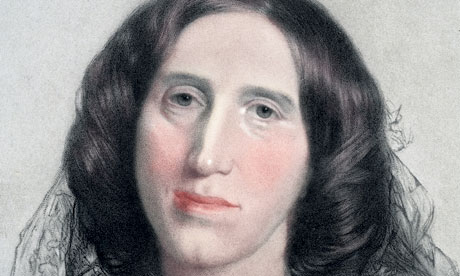
George Eliot: The Last VictorianGeorge Eliot: The Last Victorian by Kathryn Hughes
My rating: 4 of 5 stars

A very delightful and thorough biography of Marian Evans/Lewes. I'm not sure the lay reader who hasn't read at least two of Eliot's works would enjoy it, but the textual interplay between art and life was really fun to uncover. I think I actually enjoyed the beginning sections of the book when Evans was still finding her way towards fiction the most. Many fascinating letters survive from this time. One real tragedy is that no letters survive between Eliot and her longtime companion George Henry Lewes. Surely one of the most enduring and passionate literary love stories of all time, between such unlikely figures! Alas. I bet they wrote some great letters. However, still highly recommend this biography for any fan of Eliot and the Victorians!

View all my reviews

Wednesday, September 12, 2012

Self-Education

Excavating some old journals, I found these entries from Past Kirsten:

Wednesday, 6-22-94 (11 years old)

Today at Kidzart Camp we acted out the passageway of death in Greek Mythology.  I got really interested so I went to the library and checked out a book about all the Greek Gods, Goddesses and mortal heroes.  So far my favorites have all been goddesses or women.  Here are some of them: Artemis, Athena, Cassandra, Demeter, Hera (and two more I can't remember).  A lot of the goddesses + women were helpless, but these women were smart and often beat men.

Thursday, 5-11-95 (12 years old)

I have been writing every day for a week today.  Today was pretty regular.  I have also decided not to be so studious.  I am not saying that I'll never do my homework or anything like that.  I'll still try to get A's and good grades on tests but just to be more loose and not feel pressured to do schoolwork all the time.  I desperately want a pair of brown or forest green or white or dark blue corduroys.  I also need a bra that doesn't always show the straps.  Socks too!

Friday, 5-12-95

I can't wait until Monday because we get to go on our band trip.  The day we've been promised for so long is finally coming near.  I am going to bring my discman and have a seat by myself since I'm not much of a talker on road trips.  I have had a pretty good day.  Nicole is spending the night tonight.  In fact my day has been pretty exciting today.  More in other journals.  (Because I actually had six at the time.)

Friday, 12-22-95

Dear Signifa (I had now named the diary),

Only 3 more days till Christmas!  I know I'm being a bit materialist but I think everyone is in a small way.  Today I read a lot of Emily of New Moon.  It's a very sweet and good book.  We went to a friend's house which was sort of fun (being completely honest.)  I stayed up till 12:00 watching a movie about a dysfunctional family and I got a new book from Caroline, The Scarlet Letter.  I can already tell that I'm going to love it!  Each phrase drips with beautiful, rich words and it seems to be an inhuman struggle with pain and suffering which always appeals to me!  Ciao!
***
While visiting beautiful Doe Bay Resort on Orcas Island a month ago, I took a George Eliot biography from the leave-a-book, take-a-book shelf.  Now two days into an immersion and reconnection with one of my favorite novelists--especially from my formative years--I have enjoyed the portions I've devoured thus far regarding Eliot's youth.  Painfully gifted, exceedingly self-critical, and yet immensely motivated to win approval (and love), I think her story might ring a few bells of recognition for most of us adults that grew up as bookish, shy, and awkward children.  I know it certainly does for me!

I include most of of these old diary entries of mine simply because they make me laugh, but I was also surprised, on looking through some of my old journals and papers (being a prodigious diarist at the time) at how--alongside the predictably hilarious laments about acne and sixth grade crushes--I was clearly preoccupied with my school success and fledgling intellectual endeavors , holding myself to a rigid standard of excellence.  Of course this makes sense, as at the time I was a plain and oft-teased girl without the charms of bubblyness and prettiness that usually endear little girls to adults and peers.  I was too tall and had little to no interest in sports or other rowdy games.  Any extant picture from that time has been shoved into the deepest, darkest drawer of my old desk, so you'll just have to take my word for it: picture a stork with a pot belly, bowl cut, braces, and huge round glasses.  Banded together with the few friends I had (all of whom were also bookish, and remain close friends to this day), I found that the one thing I could do was schoolwork.  I loved to read (of course), and alongside this, I had an ambitious streak, and found that mastering schoolwork was the sole route available to me for distinguishing myself and winning praise.  Because, oh yes, like anyone, I loved praise.  I was not in it merely for the joy of learning.  It surprises me to find diary entries dating back to the 4th grade in which I recorded staying up until nearly midnight in order to study and complete assignments.  Fourth grade!  Apparently, I have been working on those procrastination and cramming skills for a very long time.

Reading itself, however, was an enduring joy.  I remember clearly the summer I spent obsessed with the Greek myths.  At my insistence, Dad took me to the local library, where I checked out a ponderous cloth-bound volume entitled A Dictionary to All Greek and Roman Mythologies.  I turned page after page of myths, laboriously cross-referencing the goddesses and heroes mentioned with the appendix in the back.  I encountered a lot of "Rapes" in this endeavor.  The Rape of Proserpine.  The Rape of Leta.  Huh, I thought at the time, but in all these pictures it just looks like someone's picking a woman up and carrying her around.  (I hadn't really figured out the illustrations or statuary depictions yet.)  I penned a little skit about being a messenger from the Underworld and wrote many small poems from the point of view of gods and goddesses.  In other words, I was in total adolescent nerd heaven.

I also remember how the early classics I read completely walloped me, especially the Brontes.  I loved Jane Eyre so much, I felt she might be a literary stand-in for myself.  I related especially to her feelings of mousiness, smallness, and inhibition.  At the same time, her radical bravery and demand for egalitarian love inspired me, and gave me hope that despite what I felt to be my unlovable exterior, my inner worth might someday be discovered.  I would surmise that any young person reading such a book at such an age might have similarly powerful feelings of identification with the young narrator.  Indeed, the novel is most enjoyable to read as a young person, in my opinion.  This set off a programme that continued through my early college years of "serious" fiction and poetry reading.  Interested only in what the Canon deemed the Classics, I scanned lists with titles such as "100 Best Books of the 20th Century" and "100 Greatest Novels," starred the books that looked interesting, and then read them one by one as my pleasure reading, or on summer holidays.  For a long time, I turned up my nose at contemporary, and most American literature, preferring instead to plod through a random selection of world literature greats.  Thank goodness, too!

Kathryn Hughes' biography of Eliot does bring to mind colors of my own girlhood and self-education in literature.  Eliot's self-education is a whole other marvel in erudition and intellectual rigor, so mine pales considerably in comparison, as does my intellect, of course.  A George Eliot is only born once or twice a century.  However, reacquainting myself with her august, looming presence over English literature, and over my own influences as a writer, I realize that in my childhood efforts, Eliot was just the sort of person I sought to copy.  More so than any writer, even writers whose works have moved me equally, and on a more adult footing, Eliot, the Brontes, and Austen were my original authorial heroines.  They were the first authors who affirmed for me that even someone obscure, plain (because I remained obsessed with this self-fashioning for many years), and even unpleasant could become "great" and be remembered for years to come.  And, I should mention, reading of the young Eliot, I am reminded of how arrogant and often priggish I could be as a girl--inflating my sense of self-importance in accordance with my belief that only great people could understand a soul such as my own.  That self is certainly the most painful to remember now that I have entered a well-adjusted adulthood and have long been reconciled to my own limits of intellect and influence.  As I said, there can only be one or two Eliots, and luckily, after about the age of 14, I cooled down a bit with my pumped up self-opinion and became a more pleasant, social, and (interestingly) less obsessive person.

Still, I have been interested in revisiting this long-buried childhood self because it was this same stubborn girl that chose writing as her metier at the age of six and insisted through the twenty-three intervening years that this was the thing--the thing I was destined to do.  I suppose, after all this time, that I am still invested in believing that girl.  I have to be.  This year I'm supposed to be doing the thing for real, for keeps.  I am starting to say it, more and more.  "I am a writer."  I have doubted myself many times, especially through my unfocused and pleasure-loving twenties, but here I am, alone, away from most of my friends and the urban center I've called home for six years.  I'm sitting here in my parents' house, sequestered with a book and journal and computer, and I am writing.  Painfully, and sometimes joyfully, I am doing the thing.  Ironic, isn't it, how our younger selves are so foolhardy and yet so full of fierce belief?  If I had given young me the (totally true) spiel about how hard it is to be published these days and how the state of publishing is perilous and how it's so hard to find time to write, she would have looked back at me, blinking behind those gigantic wireframes, and said So?  You just have to do it.  Her blind, arrogant, and foolish belief is, in many ways, exactly what I need.

Tuesday, March 13, 2012

Just Shelved

The Rings of SaturnThe Rings of Saturn by Winfried Georg Sebald

My rating: 5 of 5 stars

The past year has been my year of reading European travelogues--Sir Patrick Leigh Fermor, Rebecca West, Lawrence Durrell, and now W.G. Sebald. Except none of these books are actually travelogues, any more than a novel is simply a story. They are compendiums. They are philosophical treatises. They are everything. Only--the writers have composed them while rambling. Place looms down into the works. Place catalyzes.

The Rings of Saturn is one of the most beautiful of all. Temporally, the author walks through an area that I myself have seen, so my love wells a little from nostalgia. Even without a familiarity with the Anglian countryside, however, there is no doubt this book is a masterpiece. I don't use that word lightly, but if a work of art can make one see the beauty and inscrutability and humor and cruelty and cravenness and mechanization of human beings side by side with the mysterious things they have built and created, and condemn the darkness of our souls, while still wanting to live, while still, in fact, loving that most tenuous of gifts--well, then isn't that work of art doing all that it is possible to do? Along the way, I learned about the last Chinese empress, silkworms, abandoned missile silos, crumbling country estates, Joseph Conrad, Chateaubriand, Rembrandt's painting of a dissection...I learned so much. Each section ended with a note of pleasure, like a cello string being plucked deep inside the sternum. I dreamed all kinds of beautiful dreams when I finished the book. I was changed by it.

View all my reviews

Friday, February 10, 2012

Just Shelved

So Long, See You TomorrowSo Long, See You Tomorrow by William Maxwell

My rating: 4 of 5 stars

A master class in saying everything in just a few words.


The Tiger's WifeThe Tiger's Wife by Téa Obreht

My rating: 3 of 5 stars

If you've read this book, tell me if you wouldn't rather it be called The Deathless Man. I resisted the neat tie-up at the end. I like my packages messier these days, with lots of loose ribbon.


Louise in LoveLouise in Love by Mary Jo Bang

My rating: 4 of 5 stars

Reading: participation in the construction of an artifice; the construction of a dream.


View all my reviews

Sunday, December 18, 2011

Just Shelved

The White AlbumThe White Album by Joan Didion

My rating: 4 of 5 stars

Joan Didion has the same rare and inimitable style as Dame Rebecca West. She coolly observes the scene around her, and when she makes a pronouncement on anything--whether it be Jim Morrison, the Hoover Dam, shopping centers, or her own neuroses--she does so like someone ringing a clear, pure bell. It sounds, and it seems final; it seems bare and essential. I don't know how she manages to do this in such an economy of words, but she does. This collection of micro-essays comes together and does more than simply sketch the end of the sixties in Southern California; it does something more rare, imparts a flavor, a re-animation. One imagines Didion slipping into the background of any scene wearing huge glasses, able to seem both invisible and authoritative. I hope this bell continues to sound.

View all my reviews


My rating: 3 of 5 stars

I read this book very quickly--it has one of those puzzlebox plots, where one awaits a conclusion that ties the intersecting storylines together. I would say it's enjoyable to read, and the prose is very smooth (lots of periodic sentences...don't fear the semi-colon or the dash, Nicole). Somewhere deep down, however, I didn't entirely buy it. The objects and personal failings/obsessions that catalyzed so much repetitive sorrow for the characters didn't seem believable to me. The voices of the characters themselves were engrossing--some more than others--and I believed in the grief of their pasts (except for the lady novelist who writes successfully from her ivory tower but bemoans her ability to connect with others). I don't believe in grief that's entirely organized around an object or destructive fixation, however. By the end of the book, the poor desk of Great House groaned beneath the weight of so much symbolic significance. I would still be interested to read other work by Krauss, however.

Thursday, November 3, 2011

Just Shelved

The Swerve: How the World Became ModernThe Swerve: How the World Became Modern by Stephen Greenblatt

My rating: 4 of 5 stars

If you are the kind of person who thinks finding a crumbling old manuscript in a dank monastery that turns out to be a fascinating glimpse into a nearly-vanished pagan philosophy on living written in verse would be cool...then you and I have a lot in common, and we both like this book already. We are also both nerds, and that's okay. We should probably travel together in order to avoid irritating our companions.

Greenblatt is clearly a scholar of considerable erudition on the Renaissance and European art and thought. While very engagingly written, I do sense that Swerve was written for the general reader rather than a more specialized audience. Perhaps because I have studied and written on similar subjects in the past, I yearned for more overtly scholarly writing (which does NOT have to be boring--The Age of Wonder and its endlessly-entrancing digressions comes to mind). I would have been happy to read several hundred more pages, especially about the ripple effect in Renaissance art that Greenblatt cunningly traces back to the discovery of Lucretius' poem. More than anything, I realized that going to the primary text--"On the Nature of Things" itself--will be the key to serious explorations of this subject.

So, on the hunt I go, but with some delightful background knowledge to buoy me.

View all my reviews

Sunday, October 9, 2011

Just Shelved

My rating: 4 of 5 stars

Great collection entirely comprised of up-and-coming (and firmly established) female writers of fantastical, fabulist, and, well...weird fiction. I loved the presentation and careful curation of this book--clearly exciting things are happening at Tin House. Some of the bigger names (Lydia Davis; Miranda July) were represented by fairly slight (dare I say lazy?) pieces, but there were plenty of other gems and new writers to discover. A few stories tended towards the fey or overly cute--always a risk of this genre--but there was enough unsettling, and indeed, unfeminine, weirdness to go around. I also think the tone of fantastic fiction lends itself well to describe coming-of-age journeys: a freakish time, indeed.

Particular favorites:

Aimee Bender's "Americca"
Judy Budnitz's "Abroad"
Julia Elliott's "The Wilds"
Samantha Hunt's "Beast"
Kelly Link's "Light"
Lydia Millet's "Snow White, Rose Red"
Alissa Nutting's "Hot, Fast, and Sad"
Stacey Richter's "The Doll Awakens"
Karen Russell's "The Seagull Army Descends on Strong Beach" (my favorite)
Gina Zucker's "Big People"

Sunday, September 18, 2011

Just Shelved

My rating: 3 of 5 stars

This is one of the better Best American collections I've read. There weren't any stories I disliked, though as usual, some were far more memorable than others. Here are the gold star stories:

E.L. Doctorow's "A House on the Plains"--So creepy and well-done in its incremental reveal of disturbing information. Pitch perfect voice.

Melissa Hardy's "The Heifer"--Not as striking as some of the others, but great prose and a bit of comedy, too.

Alice Mattison's "In Case We're Separated"--A more traditional relationship story, but very well-done, with a poignant ending.

Jill McCorkle's "Billy Goats"--Worth a read for the communal narration.

Alice Munro's "Family Furnishings"--Of course. And extra intriguing for its glimpse into autobiographical details of this master's life. The finest story of the collection, in my opinion.

The stories by Akhil Sharma, Mary Yukari Waters, and Tom McNeal--all excellent family stories. Quite different from one another, but I enjoyed all three.

Jim Shepard's "Love and Hydrogen"--Sent me straight to Google afterwards to read up on the Hindenburg disaster. Probably my second favorite of the collection. How does he do it?! He enters the past and makes it new, fantastical, and wonderfully human. No small feat when one chooses to write about already word-saturated events.

Also liked Arthur Miller and Leonard Michaels' stories. So, actually, I suppose I'd recommend almost all of the stories.

Wednesday, September 14, 2011

Just Shelved

Justine (The Alexandria Quartet, #1)Justine by Lawrence Durrell

My rating: 2 of 5 stars

Like a banana going soft on your counter, smelling overwhelmingly--cloyingly--of itself, there seems to be something too intense about the prose in Justine, too intense about the destructive love affair it desultorily describes and discards.

I had to throw out the banana. I couldn't finish it.

If that sounds vaguely phallic to you, then I see I've hit the right tone for Durrell's prose. It's a shame, because I can honestly say that his writing in Prospero's Cell--a magical travelogue/sketch diary about the isle of Corfu--was some of the best I have ever read. Just incandescent. The prose here, however, feels bloated. I suppose it mirrors its subject somewhat: Alexandria. Can a city be bloated? Perhaps with trash and tragedy and poverty--the Alexandria inhabited by Justine and the narrator.

Read until you reach the famous line about cities taking on a new meaning once you love someone within the city. Then, honestly, you don't have to continue.

(I may actually pick Justine up again, since it does provide an interesting version of the metafictional novel. It wasn't right for me this time around, however.)

View all my reviews

Wednesday, August 17, 2011

Just Shelved

A Time of GiftsA Time of Gifts by Patrick Leigh Fermor

My rating: 5 of 5 stars


If Patrick Leigh Fermor were to hold up a sign while hitching on the highway, it might say: "Lovable scamp. Gives good prose. Charming conversationalist. Will cheerfully eat or drink anything you offer. Will feature you in book."

I would totally give him a ride.

View all my reviews

Monday, May 23, 2011

Just Shelved

As part of my (continuing) self-education about Croatia and Greece, I began these two books before and during my travels, and just wrapped them up over the past couple of weeks. Both were delightful reads, and added so much richness and depth to my experience of these places. A well-read tourist is a happy tourist!

The Impossible Country: A Journey Through the Last Days of YugoslaviaThe Impossible Country: A Journey Through the Last Days of Yugoslavia by Brian Hall

My rating: 5 of 5 stars


It is incredible--the feats of understanding and compassion that can be achieved simply by talking to people. This remarkable book holds a glass to the multiple voices of the Balkans, just as the former Yugoslavia was beginning to dissolve into violence and genocide in the early nineties. Hall, like a novelist, presents us with people and their stories first. He asks difficult--sometimes explosive--questions of those he meets while traveling throughout what is now Serbia, Croatia, Slovenia, and Bosnia. He doesn't give us an easy "answer," but he provides us with portraits, and in so doing, troubles the notion of nationalism and ethnic divisions everywhere, not only in the "impossible country." It is a deeply moving, lovingly written book.

Prospero's Cell: A Guide to the Landscape and Manners of the Island of CorfuProspero's Cell: A Guide to the Landscape and Manners of the Island of Corfu by Lawrence Durrell

My rating: 4 of 5 stars


When the Northerly wind blows, find solace here, in some of the most beautiful writing you could read. You will taste the olives. You will feel the sunshine. Corfu of the late 1930's will come alive. And you will even learn some things about Greece, and about silence.

"Presently the carbide lamp is lit and the whole miraculous underworld of the lagoon bursts into a hollow bloom--it is like the soft beautiful incandescence of a gas-mantle lighting. Transformed, like figures in a miracle, we gaze down upon a sea floor drifting with its canyons and forests and families in the faint undertow of the sea--like a just-breathing heart."

--Durrell, "Ionian Profiles"

View all my reviews

Saturday, February 5, 2011

Just Shelved

My rating: 4 of 5 stars

A must-read for anyone devoted hopelessly, helplessly, and sometimes even selfishly to books and authors. Full of delightful literary criticism, memoir, personality sketches, and excursions temporal and otherwise, The Possessed is one of the most enjoyable books I have read in a long time. It's also very funny and will add book after book to the mountain of books you were already intending to read. I had some quibbles with Batuman's attack on MFA programs in the Introduction, even though some of her points were well-taken. I also think that at times, the author's flat narrative voice can cast a tone of mockery on people that I doubt she meant to mock, such as her dedicated teachers in Uzbekistan, who were being paid less than $200 to tutor her in poetry and history for an entire summer. There were times I disagreed and felt piqued, but these feelings did not draw me away from the collection of essays; rather, they made me wish that Batuman was an acquaintance and that I could argue with her in person. I think she is a critic and writer who may very well become a big star.


Tuesday, January 4, 2011

Just Shelved

My rating: 4 of 5 stars

Solid short story collection highly worth checking out.


My rating: 4 of 5 stars

Postmodern puzzlebox of a book, linking characters' lives like a spiderweb - tenuous, touch and go. I was alternately moved and frustrated. An interesting companion piece to Cloud Atlas, which attempts similar disruptions in form. Surprisingly, the chapter that engendered the most skepticism -- a chapter told entirely in Powerpoint -- ended up being one of the most moving. I keep taking back my fourth star and then returning it. Egan, we aren't through.


Sunday, December 12, 2010

Just Shelved

My rating: 4 of 5 stars

David Mitchell is the literary equivalent of that person who can do scarily accurate impersonations of everyone. He throws himself into a pastiche of literary styles and time periods with verve and brilliance. Cloud Atlas is like five extremely provocative and entertaining novellas for the price of one. The question for me, though, is this: Are the artificial plot breakages and post-modern conveyances necessary? Is Mitchell afraid that it's not clever enough simply to be a supremely gifted storyteller? To my mind, it's the opposite. Storytelling is the true magic.


Saturday, December 4, 2010

They All Want to Play Hamlet

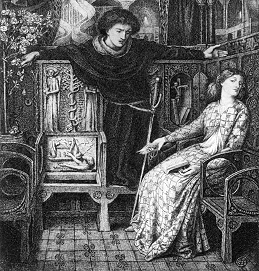
My friend and I were discussing the production of "Hamlet" we'd seen two weeks ago, and how we'd continued to probe it, remembering versions we'd seen in the past and the thoughts we'd had reading the text as younger versions of ourselves. As young women, we had fixated on the doomed romance of Hamlet and Ophelia. Ten years later, however, I identify far more with Hamlet himself and his classic wavering between thought and action; stunted resolve, and distrust of thought itself. To think and to do: these strike me as two of the greatest challenges of my twenties. The self emerges slowly, many-pointed. The world the self desires exists across a gap that can only be crossed through action, but how to turn those half-formed desires and images into the right action? That can also be the question. Of course, the character of Hamlet is far, far deeper than the mere action vs. inaction dilemma. In fact, discussing him, and how we might self-importantly identify with him, led my friend to introduce me to the following delightful poem by Carl Sandburg:

THEY all want to play Hamlet./They have not exactly seen their fathers killed/Nor their mothers in a frame-up to kill,/Nor an Ophelia dying with a dust gagging the heart,/Not exactly the spinning circles of singing golden spiders,/Not exactly this have they got at nor the meaning of flowers—O flowers, /flowers slung by a dancing girl—in the saddest play the/inkfish, Shakespeare, ever wrote;/Yet they all want to play Hamlet because it is sad like all actors are sad/and to stand by an open grave with a joker’s skull in the hand and then to say/ over slow and say over slow wise, keen, beautiful words masking a heart/that’s breaking, breaking,/This is something that calls and calls to their blood./They are acting when they talk about it and they know it is acting to be/particular about it and yet: They all want to play Hamlet.

Our hearts are breaking, breaking, and we are sad like all writers are sad. Self-importance pops, fizzes away: a deflated balloon. Still, it's interesting to consider how our relationship to texts and the characters therein change over time--in concert with our own situations in life, our richening perspectives. Once I have children, will I identify more with the blustering Polonius or the aching, mistake-riddled Gertrude?

I remember that I used to root for a reunion between Arthur Dimmesdale and Hester Prynne; now it seems preposterous that she could even tolerate his cowardly form in the first place. Jean Rhys has given me new perspective on the mad woman in the attic and her perceived "threat." I've realized that there aren't that many interesting women in The Lord of the Rings. I get bored with love stories. "But what's your job?" I feel I want to ask. I'm no longer so perturbed by Dickensian coincidence: coincidences can be magical, after all, and that's sometimes good leavening to serious bread.

So, my question is this: How has your relationship changed towards some of the beloved books and characters of your youth?

(poem published in 1922, found online here: http://www.bartleby.com/231/0206.html; image credit: http://www.theatrehistory.com/british/art_of_hamlet.html, Hamlet and Ophelia by Dante Gabriel Rossetti)