Showing posts with label art moment. Show all posts

Thursday, August 1, 2013

On Driving Western Roads


Was it Sacajawea buried here? All the people carrying burdens to hold over the Pacific ocean. All the ways a horse can lay down its head. Roads unfurling into what? The forests of Seussian trees; the carpets of wildflowers: resourceful, jaunty. Outside of Ennis, Montana, the foothills roll into blue real hills. The real blue hills fold into real blue sky. Big Sky. Plains and glaciers. Glaciated plains with their screes of debris. Cows roam. When did you decide on blue and gold? When did you decide on green? The road unfurls into dilapidated farms. The image of a Ford driving away down the road. The image of the first timid deer over the doorstep. And they – deer and antelope and foxes – flushing out onto roads or wandering the stalks of corn. The real cowboys with their round chew silhouettes; rubbed raw, back pocket. And you can still be born and still go to high school and still die in these places. The ladies used to come and look in consternation at the lakes, fanning. You can see where the photographers brought their plate glass and curtains thousands of feet up. A bear is above you; the sunset’s unfurling below. The sunset is a cloud threading its hand over the crags. The sunset is the ring of blood on the trees. The bones of original ancestors lie here. The Blackfeet called this the backbone of the world. Even Sacajawea was buried here. Even she. 

Wednesday, July 10, 2013

Artificial & Natural


Like many amateur smartphone photographers (and before smartphones, iPhoto & point-and-shoot aficionados), I take great pleasure in going to beautiful places and snapping eminently editable photos. Not that many areas in the Jackson Hole region need much of a boost in color saturation or sharpness, but still, the small tweaks here and there or the revelation of HDR make me feel that I've somehow done more than aimed and clicked. I've photographed.

Recently, I've been exploring the Gros Ventre region, which is full of pleasurable place names such as the Red and Lavender Hills, and is also the home of the most charming backcountry cabin I've ever encountered. Set betwixt a ridge and a burbling creek at the end of a scenic little dale, its outside was so perfect that I thought it might still be in use by the occasional Forest Service ranger. However, on closer examination, I found the cabin actually split in two and long-abandoned, even though its front windows still wavered with their original glass. In one side sat a 1940's era stove, and on the other, a built-in shelf and table. As to its owner, an hour of feverish internet research produced nothing, though I did uncover a snooty entry from an evaluator criticizing another Gros Ventre cabin's entry in the National Register of Historic Places. Historian snobbery, alive and well.

Klimt Stone

The Gros Ventre is defined by a massive 1925 landslide that brought an entire side of Sheep Mountain down in a crush of tons of rock and trees. The slide, in turn, dammed the Gros Ventre River to form Lower Slide Lake (the "Gros Ventre Slide" is also a locally-beloved breakfast dish at The Bunnery). Two years later, part of the dam gave way, flooding the nearby town of Kelly almost out of existence. Because of its devastation in the flood, Jackson stepped forward to become of the county seat of Teton County.

Evidence of the slide has not dissipated in the ninety odd years since it happened. Huge boulder fields and drowned trees rising eerily from the lake still attest to this past natural violence. Primarily composed of sedimentary Tensleep Sandstone, the rocks and boulders ejected from the mountainside have sometimes an orangish hue and are speckled with bright splotches of many-colored lichen. In my head, I've begun calling it Klimt Stone because this reminds me of Klimt's metallic, speckled, and variegated paint textures.

Burnt trees also lend themselves well to being re-interpreted and morphed into looming, portentous signifiers. The following was on an unnamed ridge (at least, unknown to me) bordering Granite Creek, which is south of Jackson. Against bluer-than-blue skies, the carbonized skin glitters--a stalk of coal.

And this brings us to cloudscapes--perhaps the easiest to manipulate into technicolor visions, mimicking the layering of paint pigment in the depth of the alabaster, the lemon, the champagne. Dialing up a cloudscape brings baroque and rococo heavenly vistas to mind--those windows into ethereality usually guarded by chubby putti with trumpets and garlands. The cherubim don't work for free in Wyoming, however. I've seen plenty of rare animals, including a wolverine (!), but so far, no swirling celestial babies. I'll keep you posted.


As I continue to walk the woods, thinking of my book, and continue to indulge my side interest in documenting new hikes and spectacles, the vividness of real nature and the artificiality of art and nature-translated-to-image continue to inform one another. Sometimes reading is the most vivid thing of all; sometimes writing feels like the shoddiest paintbrush to communicate what is real. Regardless, the richness of a life lived in art and in landscape imparts a reverence for all that hallows, communicates, and beautifies experience. The one is essential to the other.


(Painting: "Adele Bloch Bauer," Gustav Klimt)


Sunday, June 9, 2013

Green Vibrations


I am thinking over a phrase of Annie Dillard's this morning, encountered in her collection of meditations on writing, appropriately titled The Writing Life. "There is no shortage of good days," she writes. "It is good lives that are hard to come by. A life of good days lived in the senses is not enough. The life of sensation is the life of greed; it requires more and more. The life of the spirit requires less and less; time is ample and its passage sweet. Who would call a day spent reading a good day? But a life spent reading -- that is a good life."

It's an uncomfortably wise insight. Although I have never confused sensation-seeking with writerly preparation, it has nevertheless been an underlying motivator in many things I have done. I always feel an anxiety about missing things, or allowing experiences to remain undiscovered. In Jackson, it is some mythical canyon that haunts me: somehow obscure and crystalline; a field of wildflowers where no one is walking; a view from so high, that as I wrote once, "I can feel the cold on my eyes." Other places, it is about the potential of art, the potential of hitting just the right point of intoxication on food or wine, the potential that some person hides behind one of many turned shoulders, and that person has keys to unlock any number of things. It's what leaves me hungrily scanning the walls of cathedrals, looking for the original, homely paintwork, obsessed with even the humblest joints of the ceilings. I'd hate to think I missed it.

I think my assumption has always been that these moments of beauty will accrete, one layer of sand to the next, to make my soul altogether something fine and glittering, honed carefully and curated as I go. And yet, I often write so little of it. Why, I wonder.

Summer is upon us now, with its exquisite songbirds and trails, cleared at last of snow. In mid-May, it seemed that all the aspens and cottonwoods turned green at once. I thought of it as a susurration of some kind, completely undetectable to human ears, but nevertheless communicating spring through the groves, vibrating the landscape into a new incarnation of being. The green was so new; the operation itself so delicate. A miracle was gifted in a day, but a quotidian miracle, too, happening each May in a sudden sweep. And then summer. And then the sun and the obstinate eggshell blue.

It is a time of golden water in the evenings, and green trees etched in gold around it. The yellow of balsamroot flowers and the sentinels of violet lupine and monk's hood. Baby elk, tremulous on newly-jointed legs; a rather fat and pleased-with-himself marmot, like a caricature of an English friar; a miniscule duck who fed at the edge of a quiet stream, buoyantly bobbing up after each quarry.

A hard thing it is, to revise, when all of this is happening outside. The outdoors are a constant imprecation to leave the room and abandon the work. That mythical canyon taunts like a mirage. But ho hum,  another chance to gather strength and plug along anyway. To remember the life of the spirit. So many moments of muster, and then finally, I write about this color of green at last, and let go of that last nagging sensation, returning concentration to where it ought to be.


Saturday, April 27, 2013

Endings and New Beginnings

This morning, I couldn't sleep, so once more, I pulled out the warm slab of my laptop, and let its screen keep me company in that early hour (early for me, anyway), as the light of a new day spread across the walls and the floors.

Ten minutes ago, my wonderful sister and her wonderful boyfriend Sam brought me a mimosa and breakfast in bed (woot!) . Their timing couldn't have been better, because just moments before, I wrote the last sentence of my novel draft. Time to celebrate the next step, a new year, and a new decade.

It feels a little surreal and emotional. Soon, we will be packing up and heading for two days of relaxation in Montana. I'm bringing books, but not my book. Of course, there is still work to do. Hello, revision and rewrites! But for now, I'm settled in with the happiness of being done and leaving behind this stage for a new one, just as my character did an hour ago, crossing into her imagined future and spinning out into the ether of narrative possibility.

I want to toast my beautiful, supportive family and my wonderful friends and cheerleaders. I am so lucky to have you along on this ride. Your love, even from afar, gives me faith in myself and humankind in general. See, I told you this was the year of feeling feelings!

Okay, it's party time. Raising a glass to all of you!

Saturday, April 20, 2013

Marking Time With Words


Spring is a brown time in Wyoming. I noticed this anew as my plane flew low over the hills two days ago. Each time, I can pick out the road that curves against the bluffs south of town, and then we fly over one of the low hills that marks my own neighborhood, over the entirety of the town grid, and touch down--spectacularly--at the base of the snowcapped Tetons. That's what I noticed, however, as we flew over: a neverending swath of brown, and all the mountains still encased in snow. Bison welcomed me back, as did an intrepid weasel that somehow snuck into our suburban home, crept into my room, and, in illustration of every possible rodent horror story, hopped right onto the bed. This is the west, after all.

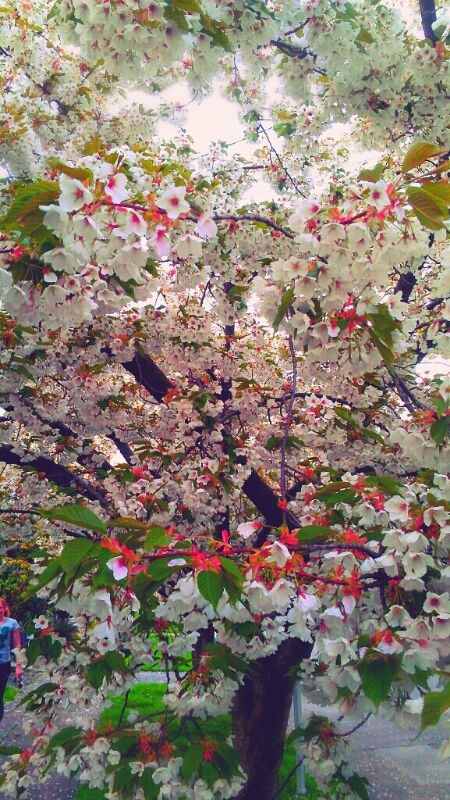
I was flying back from Seattle, my home of seven years, and where I had spent two luxurious weeks visiting with friends, celebrating a wedding, and remembering the riot of spring. Cherry blossoms, dogwoods, tulips, magnolias. Spring in Seattle is a time of carpet petals and palm-sized camellia flowers that fall, often unblemished, directly to the grass. It is a time of chill winds and spitting rain and oddly timed sunbreaks, too, but I couldn't help but feel that I'd picked an almost tropical locale as snow continued to drift in my hometown and the thermometer dropped back down to winter temperatures.

What does it feel like to be back in Seattle? It's an odd disjunction--more familiar to me in many senses than my life in Jackson, and yet the tugs of loyalty to Wyoming were there, too, as if, in choosing to spend these months in the mountains, I must swear fealty again to my vision, even as the warmth of my friends and the verdant scenery were things I could slip back into so naturally. I caught up with my friend Jessica, who now makes her home in the Bay Area after years spent in Seattle as well, and she remarked that visiting the city now feels like it once did to visit her hometown. This seems about right: the instant, comforting embrace of the known, not tinged by nostalgia, but rather by a deep sense of recognition. A marvel over what has changed, and yet an ease with what has not been forgotten: the buses I take, where we should choose a restaurant, where I should buy a book of poetry.


It's been months since I've ridden buses, and while I sat on one reading, I realized that the city had created a mode of thought for me in the rhythm of how I got from place to place; in the cadence of my walking, in my notation of businesses I passed, in my constant state of being around others in public spaces, and yet often burrowed into my own solitude. It was the same as I rode the bus from Portland to Seattle on a Sunday evening, a continuing drama of glowering clouds, rainbows, and sun outside the windows. I tried to take a picture of the clouds out of the glass, but I ended up taking one with the strip of setting sun from the opposite aisle smeared along the bottom of the frame. Like a double exposure or two counterpanes, tissue-thin, existing side by side. This was the feeling of being in Seattle. My old life close enough to taste and easy enough to resume, my new one waiting anxiously, afraid of being abandoned.

And yet. Part of living in Jackson feels like coming back to the beginning in the best way. Here, I have found new ways to think, too. In cars, playing my music and singing along like a banshee. On long, aimless walks while our dog Iris bounds unbidden into fields to chase the birds. In the feeling of electricity whenever a coyote howl pierces the dead of night or yes, even when a weasel sneaks into the house and brings everything that is outside, inside. I know the big question hangs there, swollen with the accumulation of months: Where will you go? And the truth is, I still don't know. I suppose I am still living the questions. I suppose my journey is meant to go a little further. At least the scenery will not disappoint. And at least I am reminded of the dear friends who support me and mean so much to me and whose much-needed company will no doubt buoy me through the rest of this month and beyond.

I am also turning 30 a week from today. It's a milestone that I want to meet with a marker. This week, I will complete my book. So, when I say I am marking time with words, I mean it very explicitly. This is the week. I will be holing myself up for as long as it takes so that I can emerge on the dawning day of my next decade and know that one thing I did in my twenties was finish my book. I will put the dot at the bottom of that question mark. I will move to the next sentence. And then, it will be time to move onto living another question, to finding another path in the trees.

Sunday, March 3, 2013

Gold Leaf Fixations

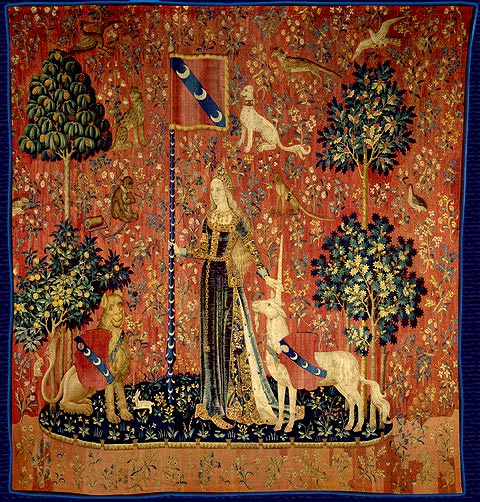
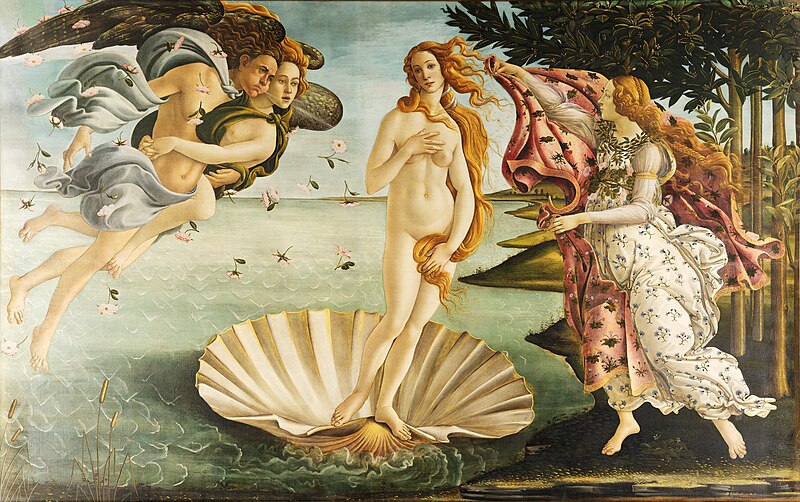
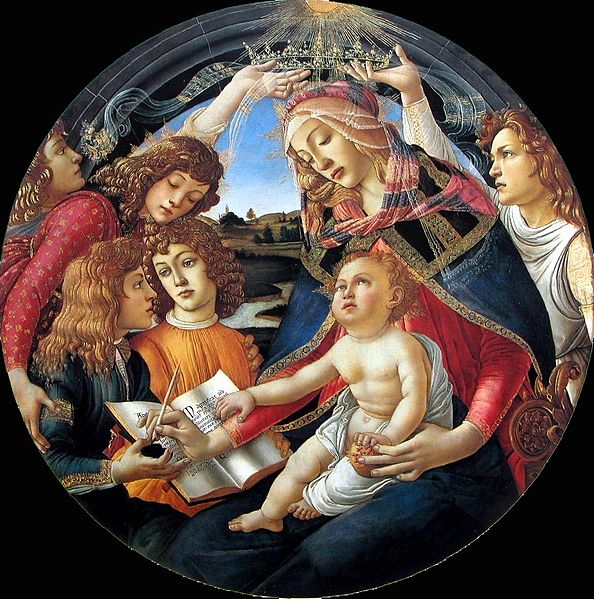
As writers, I think we cycle through various fixations. At different points of my life, I have been obsessed with silent film stars, describing snow, the personal effects of dead people, and medieval tapestries. The list goes on... Currently, I can't stop myself from Googling images and clips of classical ballet dancers. Curiosity feeds my art, even when there will be no pointe shoes in what I'm writing now, and only a little snow. Sick, sniffly, and cranky today, I combed through my own writerly archives and found these quite ancient poems. They brought me right back to my medieval portraiture/gold women fixation of seven years ago. I had just traveled to Europe that summer, and saw the Lady and the Unicorn tapestries in person. I loved those arch, stiff figures, and the symbolically mysterious cornucopia of creatures fixed at awkward angles around the maidens. Back in Seattle, I was cutting apart an old calendar of Botticelli's most famous paintings, and his flaxen-haired maidens painted centuries later called me back right away to the tapestries. Those same blonde maidens with the same faces, cast again and again as Madonnas and Venuses and Muses. I guess I'm still a little in love with them. Anyway, these two ekphrastastic (new word!) poems came directly from two of those uber-famous works. I post them here because, truth be told, I never was a very good poet, and this is really the only venue informal enough to share them. Also, they are oooolllldddd. Don't judge.


After Botticelli’s Birth of Venus

I am the bone white Venus.

I cut my feet when I walked to shore;

I wore clothes that were not my own

but my breasts glinted as pearls
inside my raiments.

The children came to touch my skin.

It wouldn’t be hidden

but glowed.

You are a body of fireflies!
They exclaimed.

My hair looped around the room like the rings of Saturn
and I spit seawater onto my plate.

Excuse her for she has just been born
they said in embarrassment.

I did not know the language yet
and my old tongue fled quickly,

twisted away like gilded fish.

They could not tell I wept
thought my tears a remnant of my salted womb

like the drippings from my limbs,
bursting into bloom on the plank wood floor.

Bless us!
they clamored.

I gurgled words I knew to them, uncomprehending;
the nymphs stole in at the sound and stole cheeses from

the bell dumb crowd

as I rang and rang them with a sound like whale calls.

That wicked baby who has dogged me flew in,
pinched my nipple.

I was dreaming of the shell, tongue-pink
my kelp body, drifting

insensate

just another unfound treasure in the deep

and now diminished, diminishing

trawled out and flaking light
like the most common catch,

Caught.


After Botticelli’s Madonna del Magnificat


Oh mother of the milky skin cry the angels.

There, I shall write in your book, pageboy;
you are prettier than girls.

The corona of my baby cuts into my breast,
my fingers slide over the slick seeds of the pomegranate.

Your wrists are lilies cry the angels.

My baby is fat and transfixed and heavy;
my skin is taut over my forehead.

I can feel the angels rotating my crown like a poker traced ‘ore my scalp
ear to ear.

Your hair golds like wheat cry the angels.
Your face is beautiful and fine like a shell.

I want them to waft this baby, this weight, away;
my robes stripped off

and float aimless like a star
unknown, unheralded, unflaxed with gold,

empty as I was born.

(all images: Wikipedia)

Monday, October 1, 2012

Rounding the Seasons


A couple of days ago, I found myself longing for a specific poem about autumn.  I knew I had read it before, and that it was a well-known, oft-anthologized work.  I riffled through my memory, recalling that the poem was infused with a sense of drowsiness, the sharp smell of a cider press, the subtle-sweet scent of autumn's glorious decay.  Was it Yeats?  Something about gold, or another poem about the beloved "quiet one"?  Was it Dylan's young boy, singing in his chains by the sea?

But no, the poem I sought was Keats' "To Autumn."  "Season of mists and mellow fruitfulness" it begins, full of praise and exhortation.  There is a cider press, and a winnowing wind, and the long locks of autumn, golden in the sun.  The poem is infused with a honeyed sense of time, with languour, with, really, all those lovely -our words that signify leisure and slow time.   It sounds a bit like the autumn I am inhabiting right now--one I have not experienced in this specific setting for eleven years.  And oh, how worthy of an ode it is.

I smelled the first intimations weeks ago as I hiked into the Teton Range with my family on a very hot and sunny day.  The soft, sweet smell of the yellowing heart-shaped aspen leaves immediately conjured the first signs of an autumn I had completely forgotten.  I thought of all of the poets who have dedicated their work to each of the four seasons, and I listened to Vivaldi's "Four Seasons"--the alternating frenzy and light strings of a year's passage.  In all the years of living elsewhere, autumn was always the season I had missed.  And how could I really say I had come home again until I experienced its return--right here?  I realize now that we can never truly love--or know--a place until we have experienced it in its roundness.  Every day is a gradation in color, every day adds a new, delicate tine to the comb of the chilling breeze.  Every day is a revelation.

This morning, I drove the curve of the highway, returning home towards town, and saw the crest of the Grand Teton peeking out over mellow, pastoral hills and fields, its crags just rinsed in snow.  My soundtrack for the drive--Prokofiev's "Romeo & Juliette"--swelled with grandeur during my favorite portion of the score, which I will unashamedly admit is the ultra-romantic balcony love theme.  (So beautiful!)  Ah, yes, there loomed my beloved.  Sighted with full orchestra accompaniment.  There have been so many moments like this for me in the past month that startle me into feeling vibrantly alive and full of an intense, heart-pressing gratitude for being here at this moment in time.  For seeing this place that has been relegated into memory for eleven years through a newly-discovered season, and a newly-discovered me breathing within it.


***
(I realize all of these blogs from Jackson have ended on somewhat of a heart-swelling note of effusion so far, but what can I say?  Effusive seems to be the name of the game for me right now...  As Modest Mouse would say, Blame It On the Tetons.)

(

Tuesday, March 13, 2012

Just Shelved

The Rings of SaturnThe Rings of Saturn by Winfried Georg Sebald

My rating: 5 of 5 stars

The past year has been my year of reading European travelogues--Sir Patrick Leigh Fermor, Rebecca West, Lawrence Durrell, and now W.G. Sebald. Except none of these books are actually travelogues, any more than a novel is simply a story. They are compendiums. They are philosophical treatises. They are everything. Only--the writers have composed them while rambling. Place looms down into the works. Place catalyzes.

The Rings of Saturn is one of the most beautiful of all. Temporally, the author walks through an area that I myself have seen, so my love wells a little from nostalgia. Even without a familiarity with the Anglian countryside, however, there is no doubt this book is a masterpiece. I don't use that word lightly, but if a work of art can make one see the beauty and inscrutability and humor and cruelty and cravenness and mechanization of human beings side by side with the mysterious things they have built and created, and condemn the darkness of our souls, while still wanting to live, while still, in fact, loving that most tenuous of gifts--well, then isn't that work of art doing all that it is possible to do? Along the way, I learned about the last Chinese empress, silkworms, abandoned missile silos, crumbling country estates, Joseph Conrad, Chateaubriand, Rembrandt's painting of a dissection...I learned so much. Each section ended with a note of pleasure, like a cello string being plucked deep inside the sternum. I dreamed all kinds of beautiful dreams when I finished the book. I was changed by it.

View all my reviews

Saturday, November 19, 2011

Just Shelved

My rating: 4 of 5 stars

This is a book about the self-fashioning of an artist. A young woman surrounds herself with totems; she bends towards and away from the artistic visions of others; she finds muses and is herself a muse.

This is certainly a love story. This is about being in the right place at the right time (but surely chance meetings with Janis Joplin and Sam Shepard and William Burroughs say just as much about what kind of magnetism Smith herself must possess).

I wept through the end of Just Kids; I found it very moving as a testament to a friendship and a person and another artist. When do we become an artist? Is it when we declare it? Is it when we've been recognized for our art? Is it when we dedicate ourselves to it? Is it simply when we believe it of ourselves?

I also thought about poverty as a purifier for Smith and the circle of creatives around her in NYC during this remarkable time. I've never been comfortable with giving up material comfort for art. Smith and Mapplethorpe begin as young ascetics, and yet they're getting things done; they're making the connections they need to succeed. I believe it's a function of my background: once comfortably middle to upper middle class, forever hoping to keep that standard. But it's not hard to feel a sense of envy or nostalgia for Smith's romantic vision of art-as-sustenance, for this brave girl showing up in New York with nothing but a few possessions and a belief in where she needed to be, and making a go of it. She demonstrates blistering courage. Of course I don't have regrets, but it is provocative to consider the paths of others, especially someone like Patti Smith who began not even sure what medium would be hers, but was so clearly meant to be a VOICE, and now, successful memoirist.

Wednesday, November 9, 2011

Sunday, August 21, 2011

The Weeping of the Violins

I save things. I save playbills, airline tickets, museum plans, subway tokens, every letter I've ever received, childhood journals... I save things. Usually these saved items end up as a scurf patterning the floor of my room. However, this can sometimes be a good thing. A couple of days ago, I reclaimed a program from the general melee that I had saved from my trip to Europe in the spring. I remembered exactly why I had saved it: for one thing, it had been a glorious evening of music by a chamber quartet that we had watched in the Sala Terrena, a room in a house where Mozart had once played. Mozart, the darling of Austria, was of course the main composer presented, but the second piece, the Lento portion of Dvorak's "American Quartet" had stunned me into one of those rare moments of true sublimity. I remember being so struck--and so moved--by the experience of being transfixed in that tiny room, hearing the breaths of the performers, and seeing their faces as they leaned into this music, this feeling stretched out to us from more than a hundred years ago. Once, all culture had been like this--something experienced living, and not to be reproduced or lived in the same way again. So, now I own a copy of this beautiful music, and I hope you will enjoy it, too (Click Here!). I'm also including a little scrap I wrote in the past year about classical music. It's more of a tiny sketch, but just rediscovered it and it reminded me of this experience.

Piano Music for the Stormy-Hearted

The grand, and the crescendoed. The fingers, bone-white and ivory. The hearts of deep metal and the eyes of flashing summer and the faces of gods. Oh, the chest cavity and orchestra; the deep tuba of the last act, the violin on the night path. The cymbal crash when love is sighted. The weeping of the clarinets.

Live with no note too somber, no trill frivolous. And my God, play the keys off it. Wear the pedals thin.

(photo of the ceiling inside the Sala Terrena in Vienna)

Monday, May 30, 2011

Writers' Retreat

On Friday and Saturday, seven friends and I set off to Bainbridge Island, just over the water (but apparently in a separate cloud system) for a writers' retreat. Laptops were powered on; feet were sunned while reading; photographs were taken; food and wine and revelry flowed. I also got to catch up with another writer friend of mine who lives on Bainbridge and we talked plot and character development concerning her novel-in-progress. I left feeling very rejuvenated, and yes, I did get some writing done. I also indulged my side-hobby of sticking my camera lens very close to weird (and often dead) things. Enjoy these salty, sea-gifted fruits.


Monday, April 25, 2011

Hello, Muse!

It's funny, this sudden pocket where I want to write, where I can divine the thread of perception, where I know there are words there: supple and willing like the best lovers. From whence? Wherefore? It would be easy to believe that I am not also this person. It would be easy to believe that this is not also my brain. It would be easy to believe so many things (untrue! unjust!), and yet here, the simple fact remains. And the word on the page. And the word on the page.

Funny pocket: dear, lined in ermine. Silvery, with a silky feel. Slide into you like a tongue over the teeth: accustomed to the old drops and crags, but not the slick, hard surface which is suddenly new and sheer. Suddenly alliterative; suddenly in a fine shape. Playful like a bird with its questing beak, moving seed to the side, and moving seed to the other side. Metaphors winging up with all their associations, unspooled, suddenly saved. Months of things hoarded, moving up in an unseemly parade. Like Noah and his menagerie: two by two of timbre and shade. A trope on parade. And hope on parade.

Rare, precious, timely you came. Invocation to play; invitation to praise.

Monday, November 22, 2010

To See or Not To See?

That is the question. Luckily, in this case the answer is simple: SEE! I am referring to Seattle Shakespeare Company's current production of Hamlet, which is running through December 5th. Although Hamlet is undoubtedly my favorite of Shakespeare's plays, I have never seen a live production before, and although I've watched three of the movie versions, have not been entirely satisfied with any of them.

This time, however, I was more than satisfied. This was a lean, intelligently interpreted production of Hamlet, where the actors (Darragh Kennan in the title role) spoke their lines as if they were living them, not reciting them. There was room in this Hamlet for laughter and rumination and accusation and that wonderful ambiguity that I have always loved about the text. Is there a more profound text in the English language? Hard to say. Seeing the play and experiencing the text as a living thing, I remembered reading it for the first time in high school English. Back then, I thought about the play all the time, like a fever. A couple of years later, I came back to it again and felt the same. "Hamlet" is gloriously ambivalent; at the same time, Shakespeare creates the first truly modern character to look piercingly through the centuries and grapple with the vagaries of life and death, action and thought. Hearing some of the most famous sentences of our language being spoken aloud had an almost totemic quality to it; I heard audience members murmuring in recognition at "Frailty, thy name is woman" and "To thine own self be true" and the countless other lines that have entered our shared experience of this language. It was powerful: a sacred text brought to life, all wrapped together with the physical action and the audience--rapt, leaning forward.

There are things in heaven and earth not dreamt of in our philosophy. It's nice to be reminded of that now and again.

(photo credit: http://www.seattleshakespeare.org)

Sunday, May 23, 2010

Obsessions

A few weeks ago, I saw "Exit Through the Gift Shop," a film by reclusive British street artist Banksy. I'm about as unhip as they come regarding street artist culture, but I have to say, the film is one of the most thought-provoking pieces about art and artists that I've come across in quite some time. It begins, ostensibly, as a peek into the forbidden and secretive world of prominent street artists through the (obsessed) eyes of a dogged film-maker, who shoots tape after tape of these intrepid folks as they teeter at the bases of billboards and rooftops, pasting up large faces and mysterious down-the-rabbithole images.

Then, the film takes an unexpected turn, and becomes about the obsessed film-maker. He (Thierry Guetty) moves from chronicler of the artistic process (albeit, a chronicler who can't cohesively express what his chronicling has meant) to co-opting the artistic process of those he has followed. Banksy, a true artist and provocateur, winsomely turns the camera around to witness his acolyte becoming appropriator, as Guetty the film-maker commodifies the very art he has adored.

Among the many things the film questions, I think one of them is sincerity and appreciation. In our market culture, does a measure of appreciation eventually lead to callow and empty repetition? Is there a wringer a "real" artist must travel through in order to prove his/her authenticity? "Exit Through the Gift Shop" light-heartedly suggests a yes to this question, and I appreciated the way the film-maker flipped the script and made me probe these ideas, and the others things that fall between getting one's art up/out there and reaping profit/influence/imitators. Also, it made me feel a modicum cooler. For like an hour.

***
Continuing on the theme of obsession, I am obsessed with Richard Holmes' The Age of Wonder at the moment. I expect I will have more to say on the book when I have finished it and my thoughts have cohered a bit more, but I cannot recommend it highly enough to anyone with an interest in the Romantic period, the history of scientific experimentation, or mad, obsessed people who succeed in changing the world. A.K.A. I cannot recommend it highly enough to everyone.

Saturday, February 27, 2010

The Loving Gaze

Last night, Elizabeth, James, and I went to see Mark Doty read as part of the Poetry Series of Seattle Arts & Lectures. Oh, what a lovely reading: the crowd murmuring in delight and sadness; the writer connecting with us. My first introduction to Doty's work was his stunning, long-form lyric essay/book - Still Life With Oysters and Lemons - a deep and lovingly weighted meditation on memory and objects and seeing. The prose was breathtakingly tuned, precise. Reading that essay, and discussing its form and considered lines influenced my own prose quite a bit. I now begin sentences and paragraphs with "And" and "But" almost to excess in order to effect dramatic turns within prose, to begin new sections of writing as pointed joinders or reversals.

I admit I am not as familiar with Doty's corpus of poetry, but have always returned to one of his poems, "The Embrace," which was published in his 1998 collection, Sweet Machine. My friend Jenny handed it to me and told me it would make me cry. I glanced at the brief page, and thought "It would take more than that." Of course, I wept. It's a perfect poem; a simple evocation of love and really, really, what it means to miss someone. It makes me think of my family. It makes me want to call them. In fact, I just re-read the poem this morning (collected in Fire to Fire: New and Selected Poems) and cried again. Here it is, should you need to moisten your eyes a bit.

I think what I loved about Doty's reading, and poems, was his love. His poetic gaze lifts things; treasures things; fingers them and sets them down. The poetic moments of his poetry and prose come as a beachcombers might: a piece noticed, vaunted to transcendence through the recording of detail, connected to a moment greater than its parts, released again. Of course, this is what all writers do, poets especially, but Doty's moments feel like a glow. They feel like love itself. When turned to even quotidian subjects like dogs and turtles and goats and getting a massage in Manhattan, somehow a love infuses everything; even in sad poems, this brings the reader a kind of happiness.

In a passage excerpted from his recent book of non-fiction, Dog Years, Doty describes his old dog, lying out in a storm, and his own desperate attempts to rouse him. Before deflating the moment with a satiric "I suppose I am prone to be dramatic...," he describes the experience as bending over King Lear himself, trying to wake the old king. I've been picturing the shiny, rain-soaked side of that dog ever since, thunder roiling overhead; the dog's coat glimmering as the lightning flashed. It reminds me of a line (which I'm approximating here) from Marilynne Robinson's Gilead, where the protagonist reflects that sometimes moments seem as if they are lifted from a myth, even as you are living them. This is, of course, what made the reading of this passage so spellbinding.

Followed by an eminently warm, entertaining, and intelligent Q & A (including a great discussion of the Whitman vs. Dickinson poetic line -- these were superb questions!), we got our books signed and shuffled off home, pretty elated. Of course, I was too shy to say anything to the great writer, but at least my name is spelled correctly. I came home and wrote five fragmentary pieces of prose, just because I felt like it, and it felt so good to do that again. I rather liked what I wrote. I may share them here, since they're too slight for much else.

Anyway, it was a good evening.

Thursday, February 11, 2010

Extension

Another experience at The Pacific Northwest Ballet - this time, The Sleeping Beauty. The production was lavish, stylized, ceremonial; an exercise in pantomime. I still found it lovely, although it was so markedly different in interpretation than the sexy, throat-ripping Romeo et Juliette, which left me with an oddly sad, metallic feeling - a realization, I think, that the lovers seemed to me now reckless teenagers, when before they had seemed like a shocking comet of passion.

In the Act I of this ballet (post-prologue), the princess dances the "Rose Adagio" with her four suitors. At one point, she stands, perfectly extending one leg while balancing on the other en pointe. Betraying not so much as a wobble, she holds this pose...and holds it, as all four suitors gallantly approach her, each one elaborately twirling her about once, as if she were a top. The principal dancer in this production (Mara Vinson) was just incredible to watch, but this stilted section struck me as such a metaphor for femininity: this graceful, decorous woman holding an impossible position of display as if it were effortless; being turned and manipulated by each suitor in turn. Meanwhile, the court conjectures over who should pluck her.

Now, I don't bring this up in an angry "Boo sexism!" kind of way. Rather, the thought struck me at the time, and mingled with my amazement at Vinson's consummate athleticism. She really was breathtaking to watch. Flash forward to the next evening and, me, weeping my way through the end of "The Young Victoria" ("Oh my God but I thought these long-dead people would live forever!") This story is really one of female conquest. Prince Albert's presence is wispy, deferential, and quiet. He tells the queen "I am replaceable, and you are not." As a love story, I really liked it, but it wasn't a narrative I felt accustomed to seeing.

Three cheers for the Prince Alberts of the world (and the Victorias).

(photo credit: http://www.pnb.org/images/Season/09-10/sb_overview.jpg)

Saturday, January 9, 2010

Deceptive Delights

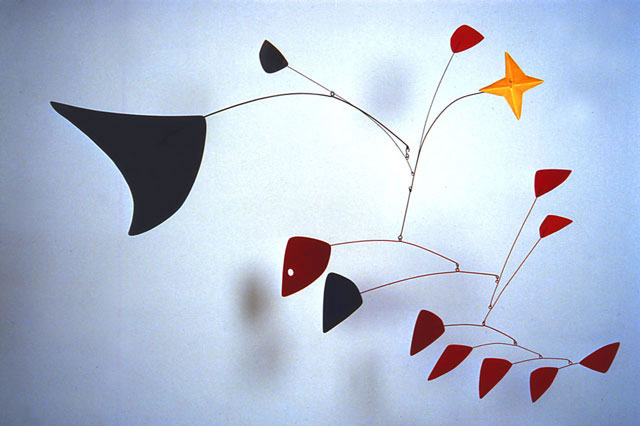
On First Thursday, some friends and I checked out the Alexander Calder exhibit at the Seattle Art Museum. I never feel that I have much of a vocabulary for responding to modern art, but the more I looked at Calder's work, especially his delicate, smaller-scale mobiles and standing pieces, the more I fell under their spell. Against the white background of the gallery walls, the shadows cast by the mobiles twisted in and out of focus, the curved shapes pulsing gently, creating another dimension to the art itself. Not harshly geometric, but rather spinning on curved axes with curved shapes, his pieces are whimsical form; awkward grace.

My favorite piece was a tall, standing mobile that looked somewhat like a modified tripod with a long neck. From across the room, it appeared to be a static sculpture, but when observed close-up, the long neck bobbed almost imperceptibly up and down, off-setting the other end of the axis to bob in response. To me, it looked like a creature breathing.

(image credit: http://www.worthpoint.com/wp-content/uploads/2008/03/alexander-calder-the-star.jpg)

Thursday, December 3, 2009

Alchemy

A couple of weeks ago, three friends and I visited the Bloedel Reserve on Bainbridge Island. Rather than describe the grounds and the meticulous planning behind them, I refer you the Reserve's own website above and this detailed account from The Intercontinental Gardener. (photo credit to the Intercontinental Gardener as well) If you live in the Washington area, I highly suggest you go, although 'tis much better to go as the guest of a member, as I did.

Towards the end of our amble, the four of us stood on one end of the reflecting pool. My friend Nicole, reading from the garden guide, informed us that the Bloedels were buried at the opposite end of the pool, and that Mrs. Bloedel's grave bore an inscription from an Emily Bronte poem, "Sympathy." She read it aloud to us:

There should be no despair for you
While nightly stars are burning;
While evening pours its silent dew,
And sunshine gilds the morning.
There should be no despair--though tears
May flow down like a river:
Are not the best beloved of years
Around your heart for ever?

They weep, you weep, it must be so;
Winds sigh as you are sighing,
And winter sheds its grief in snow
Where Autumn's leaves are lying:
Yet, these revive, and from their fate
Your fate cannot be parted:
Then, journey on, if not elate,
Still, never broken-hearted!

Now, picture this poem being read in a grave and melodious voice, with the interlocking branches of pines reflected stilly in the pool ahead, the somber water stretching forward. The fabric of all of this: the words of the poem, the voice, the pool, the wind through the branches. In a moment like this, art feels alive to me - not an unchanging object or record, but rather a thing vigorous and knotted through with life. The moment itself feels alive, and greater than the sum of its parts. It's the poem that ignites this: the laurel on nature; all the while conjuring a bittersweet mortality, the ethereal memories never lost even as the earth, and people, pass through their transitory seasons.

In my own small way, I will always dedicate a part of my consciousness to this awareness; I will always read poetry as a consecration of what we see and feel; fiction will always feel to me more true than fact. I'm glad it's that way. And I'm glad that such moments are completely democratic - they cast a spell; they take everything of the moment and briefly, ever so briefly, the moment is eternal; we share of its flare, and just by listening, we become a part of the fabric, too. We listeners and watchers are lifted in grace by a mere act of receptivity.

Our brains, our delight provide the final element of the alchemy. We ourselves catalyze the transformation.