Monday, April 25, 2011

Hello, Muse!

It's funny, this sudden pocket where I want to write, where I can divine the thread of perception, where I know there are words there: supple and willing like the best lovers. From whence? Wherefore? It would be easy to believe that I am not also this person. It would be easy to believe that this is not also my brain. It would be easy to believe so many things (untrue! unjust!), and yet here, the simple fact remains. And the word on the page. And the word on the page.

Funny pocket: dear, lined in ermine. Silvery, with a silky feel. Slide into you like a tongue over the teeth: accustomed to the old drops and crags, but not the slick, hard surface which is suddenly new and sheer. Suddenly alliterative; suddenly in a fine shape. Playful like a bird with its questing beak, moving seed to the side, and moving seed to the other side. Metaphors winging up with all their associations, unspooled, suddenly saved. Months of things hoarded, moving up in an unseemly parade. Like Noah and his menagerie: two by two of timbre and shade. A trope on parade. And hope on parade.

Rare, precious, timely you came. Invocation to play; invitation to praise.

Tuesday, March 22, 2011

Miscalculation of the Day

I just mistook a basket of of rocks for a basket of chocolates. Glad I did not attempt to bite one.

Sunday, March 6, 2011

Just Shelved

My rating: 3 of 5 stars

I read this book in an effort to give myself a crash course in the histories of some cities I will be visiting this spring. Thematically, this was a perfect book to begin with because we will be visiting Vienna first, and chronologically, the events of 1888-1889 described set in motion a chain of events that would ripple through the Balkan states, and the rest of Europe. We will be visiting Croatia after Vienna, and then Greece, so in a way, we'll be following that ripple effect across Europe.

The author, Frederic Morton, does an excellent job of creating brief but incisive anecdotal snapshots of the strata of Viennese society, from high to low, and the many people, some destined for greatness and infamy, who strolled the Ringstrasse during that fateful year. It is remarkable how many geniuses--thinkers, writers, composers, playwrights--lived in the city at that time: Freud, Mahler, Brahms, Strauss, Klimt, Herzl, Schnitzler, etc. Towards the end of the book, a great scandal occurs involving the liberal Crown Prince Rudolf and his teenaged mistress, and even though Morton sometimes overreaches in connecting this event to everything that would follow in modern life, in many ways he does have a point about rising nationalism, hysteria, and other afflictions of the "modern" era that dog us even now.

Content-wise, this is all very enjoyable and informative, but I feel I must issue a warning about the author's rather florid and repetitive writing stye. His wording is as rococo and baroque as the lavish imperial buildings of the city he describes. It's sort of like Cogsworth (oh, he of Beauty & the Beast fame) narrating an entire novel. If you can handle that, then Nervous Splendor is definitely worth a read.

Now on to the beginning of Black Lamb, Grey Falcon!


Saturday, February 5, 2011

Just Shelved

My rating: 4 of 5 stars

A must-read for anyone devoted hopelessly, helplessly, and sometimes even selfishly to books and authors. Full of delightful literary criticism, memoir, personality sketches, and excursions temporal and otherwise, The Possessed is one of the most enjoyable books I have read in a long time. It's also very funny and will add book after book to the mountain of books you were already intending to read. I had some quibbles with Batuman's attack on MFA programs in the Introduction, even though some of her points were well-taken. I also think that at times, the author's flat narrative voice can cast a tone of mockery on people that I doubt she meant to mock, such as her dedicated teachers in Uzbekistan, who were being paid less than $200 to tutor her in poetry and history for an entire summer. There were times I disagreed and felt piqued, but these feelings did not draw me away from the collection of essays; rather, they made me wish that Batuman was an acquaintance and that I could argue with her in person. I think she is a critic and writer who may very well become a big star.


Tuesday, January 4, 2011

Just Shelved

My rating: 4 of 5 stars

Solid short story collection highly worth checking out.


My rating: 4 of 5 stars

Postmodern puzzlebox of a book, linking characters' lives like a spiderweb - tenuous, touch and go. I was alternately moved and frustrated. An interesting companion piece to Cloud Atlas, which attempts similar disruptions in form. Surprisingly, the chapter that engendered the most skepticism -- a chapter told entirely in Powerpoint -- ended up being one of the most moving. I keep taking back my fourth star and then returning it. Egan, we aren't through.


Sunday, December 12, 2010

Just Shelved

My rating: 4 of 5 stars

David Mitchell is the literary equivalent of that person who can do scarily accurate impersonations of everyone. He throws himself into a pastiche of literary styles and time periods with verve and brilliance. Cloud Atlas is like five extremely provocative and entertaining novellas for the price of one. The question for me, though, is this: Are the artificial plot breakages and post-modern conveyances necessary? Is Mitchell afraid that it's not clever enough simply to be a supremely gifted storyteller? To my mind, it's the opposite. Storytelling is the true magic.


Saturday, December 4, 2010

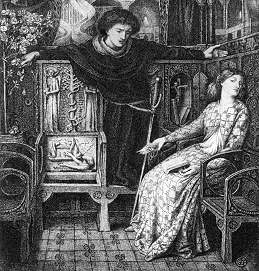
They All Want to Play Hamlet

My friend and I were discussing the production of "Hamlet" we'd seen two weeks ago, and how we'd continued to probe it, remembering versions we'd seen in the past and the thoughts we'd had reading the text as younger versions of ourselves. As young women, we had fixated on the doomed romance of Hamlet and Ophelia. Ten years later, however, I identify far more with Hamlet himself and his classic wavering between thought and action; stunted resolve, and distrust of thought itself. To think and to do: these strike me as two of the greatest challenges of my twenties. The self emerges slowly, many-pointed. The world the self desires exists across a gap that can only be crossed through action, but how to turn those half-formed desires and images into the right action? That can also be the question. Of course, the character of Hamlet is far, far deeper than the mere action vs. inaction dilemma. In fact, discussing him, and how we might self-importantly identify with him, led my friend to introduce me to the following delightful poem by Carl Sandburg:

THEY all want to play Hamlet./They have not exactly seen their fathers killed/Nor their mothers in a frame-up to kill,/Nor an Ophelia dying with a dust gagging the heart,/Not exactly the spinning circles of singing golden spiders,/Not exactly this have they got at nor the meaning of flowers—O flowers, /flowers slung by a dancing girl—in the saddest play the/inkfish, Shakespeare, ever wrote;/Yet they all want to play Hamlet because it is sad like all actors are sad/and to stand by an open grave with a joker’s skull in the hand and then to say/ over slow and say over slow wise, keen, beautiful words masking a heart/that’s breaking, breaking,/This is something that calls and calls to their blood./They are acting when they talk about it and they know it is acting to be/particular about it and yet: They all want to play Hamlet.

Our hearts are breaking, breaking, and we are sad like all writers are sad. Self-importance pops, fizzes away: a deflated balloon. Still, it's interesting to consider how our relationship to texts and the characters therein change over time--in concert with our own situations in life, our richening perspectives. Once I have children, will I identify more with the blustering Polonius or the aching, mistake-riddled Gertrude?

I remember that I used to root for a reunion between Arthur Dimmesdale and Hester Prynne; now it seems preposterous that she could even tolerate his cowardly form in the first place. Jean Rhys has given me new perspective on the mad woman in the attic and her perceived "threat." I've realized that there aren't that many interesting women in The Lord of the Rings. I get bored with love stories. "But what's your job?" I feel I want to ask. I'm no longer so perturbed by Dickensian coincidence: coincidences can be magical, after all, and that's sometimes good leavening to serious bread.

So, my question is this: How has your relationship changed towards some of the beloved books and characters of your youth?

(poem published in 1922, found online here: http://www.bartleby.com/231/0206.html; image credit: http://www.theatrehistory.com/british/art_of_hamlet.html, Hamlet and Ophelia by Dante Gabriel Rossetti)