Showing posts with label poem. Show all posts

Saturday, July 13, 2013

Just Shelved


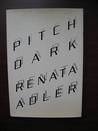
Pitch DarkPitch Dark by Renata Adler
My rating: 4 of 5 stars

Bow down to the collage novel! Long live the hybrid text!


My Love Is A Dead Arctic ExplorerMy Love Is A Dead Arctic Explorer by Paige Ackerson-Kiely
My rating: 3 of 5 stars

This collection intrigued me and I stuck with it, though in the end, it didn't stick to my ribs or blaze through with an unforgettable line. I think the more colloquial, story-telling prose poems were the most accessible of the collection, though they, too, seemed to deliberately elude a complete grasp.


My rating: 4 of 5 stars
Alternately helpful and discouraging meditations on writing; worth it for the portions set in the Pacific Northwest alone.
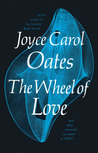


The Wheel of LoveThe Wheel of Love by Joyce Carol Oates
My rating: 4 of 5 stars

I admit that by the end of this large collection of stories, I was praying to myself, "please don't go crazy, please don't go crazy." Madness, obsessive thoughts, anxiety, drug use, familial death, and physical disfigurements all feature heavily in these dark pieces, all originally published by 1970. These are stories of their time, too: racial integration, counterculture in conflict with suburbia, trapped housewives, the decline of Detroit.

"Where Are You Going, Where Have You Been?" is by far the most famous story here, and it's really not overrated, in my opinion. I would group it among the most perfect, unsettling short stories written in the past 100 years. It's a distinctly American classic. Another classic would be "How I Contemplated the World from the Detroit House of Corrections and Began My Life Over Again." Love and sexuality loom as disruptive forces for the men and women of these stories, especially the women. Characters are paralyzed in adulterous hell or transfixed in moments of despair over a life that stretches predictably ahead. On the other side, those who choose the bohemian way fare no better. They are flying dangerously free, unmoored and despised.

Oates' stories depict a culture at a crossroads and railing within it. The smoothness of artistic production can be ripped apart by the intrusion of the other. The burden of performing personality is a sentence of permanent psychic anxiety.

From a stylistic standpoint, these are also worthwhile fictional experiments. Rather than conventional plots, many of the stories in this collection rely on snapshots in time of the same character. Sometimes, they are told backward. Sometimes, groupings of experience and advancing psychological states are captured beneath obtuse or leading subject headings. I enjoyed this organizational ingenuity and the way Oates' distinctive prose lingers on mental states and character impressions. Nothing is described dispassionately; in contrast, everything is experienced as intense, jarring, and grating on the senses. This technique does a good job in creating unease for the reader and illuminating the interiors of Oates almost uniformly troubled characters.

This was my first time reading Oates at length, but I definitely would like to read more of her fiction. I feel after completing The Wheel of Love that I've experienced that time period more viscerally than I have before.


View all my reviews

Sunday, March 3, 2013

Gold Leaf Fixations

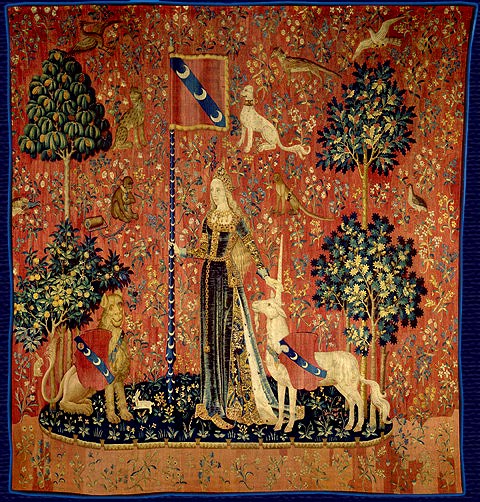
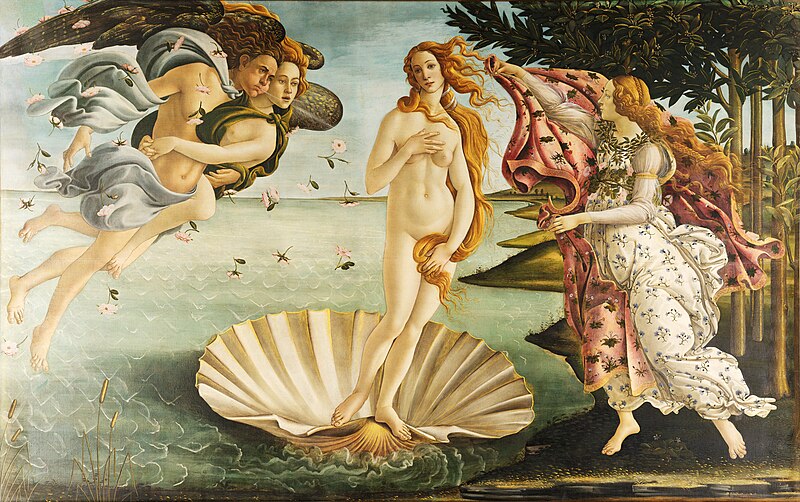
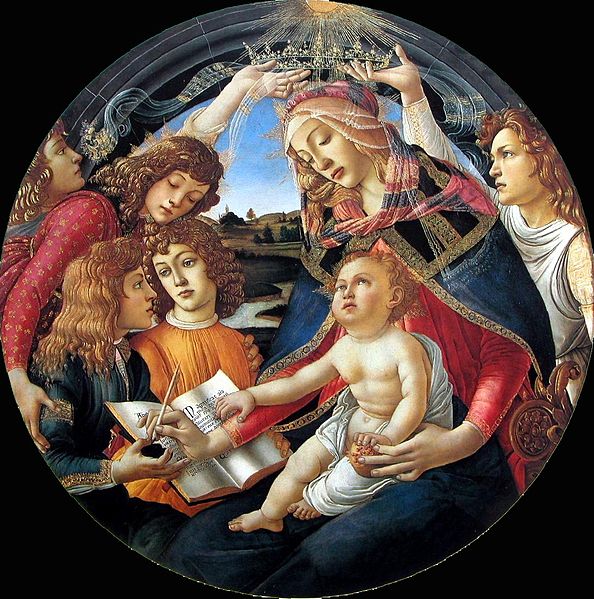
As writers, I think we cycle through various fixations. At different points of my life, I have been obsessed with silent film stars, describing snow, the personal effects of dead people, and medieval tapestries. The list goes on... Currently, I can't stop myself from Googling images and clips of classical ballet dancers. Curiosity feeds my art, even when there will be no pointe shoes in what I'm writing now, and only a little snow. Sick, sniffly, and cranky today, I combed through my own writerly archives and found these quite ancient poems. They brought me right back to my medieval portraiture/gold women fixation of seven years ago. I had just traveled to Europe that summer, and saw the Lady and the Unicorn tapestries in person. I loved those arch, stiff figures, and the symbolically mysterious cornucopia of creatures fixed at awkward angles around the maidens. Back in Seattle, I was cutting apart an old calendar of Botticelli's most famous paintings, and his flaxen-haired maidens painted centuries later called me back right away to the tapestries. Those same blonde maidens with the same faces, cast again and again as Madonnas and Venuses and Muses. I guess I'm still a little in love with them. Anyway, these two ekphrastastic (new word!) poems came directly from two of those uber-famous works. I post them here because, truth be told, I never was a very good poet, and this is really the only venue informal enough to share them. Also, they are oooolllldddd. Don't judge.


After Botticelli’s Birth of Venus

I am the bone white Venus.

I cut my feet when I walked to shore;

I wore clothes that were not my own

but my breasts glinted as pearls
inside my raiments.

The children came to touch my skin.

It wouldn’t be hidden

but glowed.

You are a body of fireflies!
They exclaimed.

My hair looped around the room like the rings of Saturn
and I spit seawater onto my plate.

Excuse her for she has just been born
they said in embarrassment.

I did not know the language yet
and my old tongue fled quickly,

twisted away like gilded fish.

They could not tell I wept
thought my tears a remnant of my salted womb

like the drippings from my limbs,
bursting into bloom on the plank wood floor.

Bless us!
they clamored.

I gurgled words I knew to them, uncomprehending;
the nymphs stole in at the sound and stole cheeses from

the bell dumb crowd

as I rang and rang them with a sound like whale calls.

That wicked baby who has dogged me flew in,
pinched my nipple.

I was dreaming of the shell, tongue-pink
my kelp body, drifting

insensate

just another unfound treasure in the deep

and now diminished, diminishing

trawled out and flaking light
like the most common catch,

Caught.


After Botticelli’s Madonna del Magnificat


Oh mother of the milky skin cry the angels.

There, I shall write in your book, pageboy;
you are prettier than girls.

The corona of my baby cuts into my breast,
my fingers slide over the slick seeds of the pomegranate.

Your wrists are lilies cry the angels.

My baby is fat and transfixed and heavy;
my skin is taut over my forehead.

I can feel the angels rotating my crown like a poker traced ‘ore my scalp
ear to ear.

Your hair golds like wheat cry the angels.
Your face is beautiful and fine like a shell.

I want them to waft this baby, this weight, away;
my robes stripped off

and float aimless like a star
unknown, unheralded, unflaxed with gold,

empty as I was born.

(all images: Wikipedia)

Friday, November 16, 2012

Potent Quotables

After the passing of poet Jack Gilbert, my friend Jessica wrote a beautiful tribute to him on her blog, and mentioned that his Paris Review interview was one of her favorites. Intrigued, I read it myself, and it's full of wisdom and just the kind of love we should wish from great artists.  Here is my favorite quote:

"I think serious poems should make something happen that’s not correct or entertaining or clever. I want something that matters to my heart, and I don’t mean “Linda left me.” I don’t want that. I’ll write that poem, but that’s not what I’m talking about. I’m talking about being in danger—as we all are—of dying. How can you spend your life on games or intricately accomplished things? And politics? Politics is fine. There’s a place to care for the injustice of the world, but that’s not what the poem is about. The poem is about the heart. Not the heart as in “I’m in love” or “my girl cheated on me”—I mean the conscious heart, the fact that we are the only things in the entire universe that know true consciousness. We’re the only things—leaving religion out of it—we’re the only things in the world that know spring is coming." --Jack Gilbert
We are also the only things in the entire universe who know winter is coming.

Friday, February 10, 2012

Just Shelved

So Long, See You TomorrowSo Long, See You Tomorrow by William Maxwell

My rating: 4 of 5 stars

A master class in saying everything in just a few words.


The Tiger's WifeThe Tiger's Wife by Téa Obreht

My rating: 3 of 5 stars

If you've read this book, tell me if you wouldn't rather it be called The Deathless Man. I resisted the neat tie-up at the end. I like my packages messier these days, with lots of loose ribbon.


Louise in LoveLouise in Love by Mary Jo Bang

My rating: 4 of 5 stars

Reading: participation in the construction of an artifice; the construction of a dream.


View all my reviews

Thursday, January 12, 2012

Verse & Reverse: A Daily Poetry and Friendship Project

Yesterday, my dear friend Maggie and I hatched a scheme over Gchat (known font of inspiration for schemes of all kinds) to trade a photograph and poem with each other every day. She will snap the photo; I will compose the poem. Our goal in all of this is to have fun, commit to a simple artistic (and low stress) exercise each day, and to emulate the Donne quote that "letters mingle souls." Below is our inaugural poem and photo pairing. Sometimes the two may inform each other, and sometimes not. You can check out Maggie's own blog and tracking of Verse & Reverse here.

Thank goodness for friends;

they make this blargish epoch

more palatable.

Saturday, February 27, 2010

The Loving Gaze

Last night, Elizabeth, James, and I went to see Mark Doty read as part of the Poetry Series of Seattle Arts & Lectures. Oh, what a lovely reading: the crowd murmuring in delight and sadness; the writer connecting with us. My first introduction to Doty's work was his stunning, long-form lyric essay/book - Still Life With Oysters and Lemons - a deep and lovingly weighted meditation on memory and objects and seeing. The prose was breathtakingly tuned, precise. Reading that essay, and discussing its form and considered lines influenced my own prose quite a bit. I now begin sentences and paragraphs with "And" and "But" almost to excess in order to effect dramatic turns within prose, to begin new sections of writing as pointed joinders or reversals.

I admit I am not as familiar with Doty's corpus of poetry, but have always returned to one of his poems, "The Embrace," which was published in his 1998 collection, Sweet Machine. My friend Jenny handed it to me and told me it would make me cry. I glanced at the brief page, and thought "It would take more than that." Of course, I wept. It's a perfect poem; a simple evocation of love and really, really, what it means to miss someone. It makes me think of my family. It makes me want to call them. In fact, I just re-read the poem this morning (collected in Fire to Fire: New and Selected Poems) and cried again. Here it is, should you need to moisten your eyes a bit.

I think what I loved about Doty's reading, and poems, was his love. His poetic gaze lifts things; treasures things; fingers them and sets them down. The poetic moments of his poetry and prose come as a beachcombers might: a piece noticed, vaunted to transcendence through the recording of detail, connected to a moment greater than its parts, released again. Of course, this is what all writers do, poets especially, but Doty's moments feel like a glow. They feel like love itself. When turned to even quotidian subjects like dogs and turtles and goats and getting a massage in Manhattan, somehow a love infuses everything; even in sad poems, this brings the reader a kind of happiness.

In a passage excerpted from his recent book of non-fiction, Dog Years, Doty describes his old dog, lying out in a storm, and his own desperate attempts to rouse him. Before deflating the moment with a satiric "I suppose I am prone to be dramatic...," he describes the experience as bending over King Lear himself, trying to wake the old king. I've been picturing the shiny, rain-soaked side of that dog ever since, thunder roiling overhead; the dog's coat glimmering as the lightning flashed. It reminds me of a line (which I'm approximating here) from Marilynne Robinson's Gilead, where the protagonist reflects that sometimes moments seem as if they are lifted from a myth, even as you are living them. This is, of course, what made the reading of this passage so spellbinding.

Followed by an eminently warm, entertaining, and intelligent Q & A (including a great discussion of the Whitman vs. Dickinson poetic line -- these were superb questions!), we got our books signed and shuffled off home, pretty elated. Of course, I was too shy to say anything to the great writer, but at least my name is spelled correctly. I came home and wrote five fragmentary pieces of prose, just because I felt like it, and it felt so good to do that again. I rather liked what I wrote. I may share them here, since they're too slight for much else.

Anyway, it was a good evening.

Tuesday, February 16, 2010

Just Shelved

Selected Poems: Anne Sexton Selected Poems: Anne Sexton by Anne Sexton


My rating: 4 of 5 stars
Dear Anne Sexton,

Thank you for your muscular rhythms, your anger, your narratives, your clear-eyed and unromantic views of mothering and sex and familial wounds. Your poems aren't always consistent, but your persona is consistently fascinating. Above all, it seems sincere. Thank you for your uncomfortable confessions; your sadness; your unerring descriptive powers. Thank you, too, for your honesty. Especially for that.

Sincerely,
This Reader

View all my reviews >>

Thursday, December 3, 2009

Alchemy

A couple of weeks ago, three friends and I visited the Bloedel Reserve on Bainbridge Island. Rather than describe the grounds and the meticulous planning behind them, I refer you the Reserve's own website above and this detailed account from The Intercontinental Gardener. (photo credit to the Intercontinental Gardener as well) If you live in the Washington area, I highly suggest you go, although 'tis much better to go as the guest of a member, as I did.

Towards the end of our amble, the four of us stood on one end of the reflecting pool. My friend Nicole, reading from the garden guide, informed us that the Bloedels were buried at the opposite end of the pool, and that Mrs. Bloedel's grave bore an inscription from an Emily Bronte poem, "Sympathy." She read it aloud to us:

There should be no despair for you
While nightly stars are burning;
While evening pours its silent dew,
And sunshine gilds the morning.
There should be no despair--though tears
May flow down like a river:
Are not the best beloved of years
Around your heart for ever?

They weep, you weep, it must be so;
Winds sigh as you are sighing,
And winter sheds its grief in snow
Where Autumn's leaves are lying:
Yet, these revive, and from their fate
Your fate cannot be parted:
Then, journey on, if not elate,
Still, never broken-hearted!

Now, picture this poem being read in a grave and melodious voice, with the interlocking branches of pines reflected stilly in the pool ahead, the somber water stretching forward. The fabric of all of this: the words of the poem, the voice, the pool, the wind through the branches. In a moment like this, art feels alive to me - not an unchanging object or record, but rather a thing vigorous and knotted through with life. The moment itself feels alive, and greater than the sum of its parts. It's the poem that ignites this: the laurel on nature; all the while conjuring a bittersweet mortality, the ethereal memories never lost even as the earth, and people, pass through their transitory seasons.

In my own small way, I will always dedicate a part of my consciousness to this awareness; I will always read poetry as a consecration of what we see and feel; fiction will always feel to me more true than fact. I'm glad it's that way. And I'm glad that such moments are completely democratic - they cast a spell; they take everything of the moment and briefly, ever so briefly, the moment is eternal; we share of its flare, and just by listening, we become a part of the fabric, too. We listeners and watchers are lifted in grace by a mere act of receptivity.

Our brains, our delight provide the final element of the alchemy. We ourselves catalyze the transformation.

Tuesday, November 17, 2009

Food Poem the Second

The holidays make me silly. And hungry.

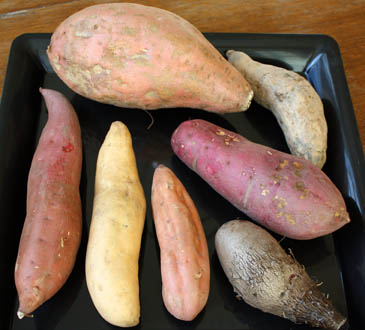
I Yam What I Yam

Let not this tuft
of scruffy stuff
obscure the gold within --
that starchy, mellow
melanin.

For though I be a humble
spud,
I give:
a joy,
a boon,
a happy tongue.

(photo credit: http://zoebakes.com/wp-content/uploads/2008/11/yams-vs-sweetp01.jpg)

Thursday, November 12, 2009

Take Two


Yesterday, I had the opportunity to check out Not From Around Here: A Series of Unlikelihoods at the Rendezvous Jewelbox Theatre (a venue I am beginning to associate with lively reading parties). It was a project by a local arts collective called The Heroes, many of whom I know personally. I loved this reading, primarily because it was about collaboration: an exploration of memory map-making set to movement; a lyric collage piece haunted by the cello; a series of eerily soulless modern apartment complexes flashing in contrast to the personal story contained therein. Oh, and there was a rap. And it was awesome. Anyway, kudos to these artists, literary and otherwise, for finding ways to create contextual performances that are as entertaining as they are meditative on the chosen subject of place.

Here is my friend Carrie reading her piece, "Vagaries":

Not From Around Here - Vagaries by Carrie A. Purcell from Bond Huberman on Vimeo.


***

Here is a silly poem I wrote about beets last week. They are gorgeous. Who knew? I have mainly only eaten the pickled variety before, and am all aflutter with how they dye the water and your hands...and everything. Oh, and speaking of food, donate to your local food bank for the holidays!

***

Beet It

Oh, beet,

amaranth,

brother of chard,

sister of mangelwurzel.

May you dye our fingers ruby,

may you jewel the water boiled.

You smell of sweetness,

beet.

And you’ll be eaten,

beet.

***

So, that was Part Two of this great adventure.